Showing posts with label Crops. Show all posts

Thursday, February 25, 2010

Not your father's cab

New tractors feature tantalizing creature comforts

The future of farming was displayed in full grandeur at the 45th National Farm Machinery Show in Louisville, KY this month. As in the years before, producers dispersed among rows of glistening machinery to catch of glimpse of what’s new. But it’s not just about being bigger or more powerful these days—it’s also about the operator experience.

Helping operators work more comfortably and productively has become an industry wide trend, and the results are visible especially in today’s tractors. Changes in cab design are much more than an extra cup holder or wider seat; every detail is designed to provide superior comfort, convenience and control throughout the workday and best suit the needs of modern producers.

“It’s always exciting to see what new features they come up with for tractors,” says Iowa farmer, Ray Hinkley. “When I first started driving tractor 30 some years ago you never thought about things like comfy seats or controls—it was all about the work, about horse power and pulling equipment.”

For those who have endured the past generations of tractor cabs like Hinkley, the improved designs are a welcome feature. “I remember what is was like to bounce around in a loud tractor cab all day, it would just wear your body down,” Hinkley says. “But with these new tractors and better cabs it’s quiet and comfortable-- some days it hardly feels like work at all.”

Climb into a John Deere 8RT Series tractor and try out the CommandView II Cab. It offers a roomy work environment, easy-to-use monitors and controls and better visibility. The seat is built using cut-and-sew cushion construction, adjustable backrest angle, and lumbar support controls for increased operator comfort. Many of the features and controls that were on the right-hand console have been integrated into the CommandARM. The controls and CommandCenter now follow the operator as the seat swivels for added comfort. The 7-in color display is divided into three regions and can be partially configured by the operator to monitor three tractor functions of their choice. Overall, the series offers 10% more cab volume, 7% more glass area and four times more storage area over the previous CommandView cab.

Relaxing into something red from the Case IH Magnum series is easy with the Surveyor cab. Take in the view with panoramic curved glass; comfortable, positive response seat; and ergonomic armrest controls. The right-hand controls in all Magnum models include: Speed, direction, hydraulics, hitch, PTO and end-of-row switch all within reach, integrated gear/throttle control handle, and an optional electronic joystick. With six power outlets, ample storage, and a large workstation to the left of the seat to holds papers, a laptop computer or other items it could be a functional mobile office.

For those who prefer the blue hue, New Holland’s T7000 tractor offers plenty of creature comforts. The ultra-quiet, high-visibility cab boasts 63 square feet of glass providing an unobstructed view in every direction. A high-visibility roof panel also provides an upward view for loader work. The new Sidewinder II armrest electronically slides forward or back to suit each operator and includes a standard multi-function controller, throttle and electronic draft controls that travel with the seat. Additional features for the cab include a new cool-box option for keeping beverages and snacks chilled and a standard enhanced keypad for tracking engine hours, distance traveled and more.

The AGCO DT Series tractors also stepped up to the plate with a totally new cab design. The 4-post cab has a 28% increase in cab space, giving it the largest cab in its size class. It features more room for the person in the instructor’s seat, a redesigned armrest-mounted console that puts all key functions where they are most convenient and one of the quietest interior sound ratings in the industry at just 71 decibels. With a larger field cooler and a field office that includes a cell phone holder and outlet this cab is ready for hours of work.

Regardless of the size, shape or color it’s obvious that tractor cabs have come a long way over the years. “If it wasn’t for the better equipment and new cabs, I couldn’t keep going like I am,” Hinkley says. “Farming is hard work but the new improvements make it much easier.”


Tuesday, January 5, 2010

Fruitful Plains

A mouth watering look at Kansas grown produce.


For some Midwest farmers agriculture is not about amber waves of grain, but rather the fruitful plains.

Nestled near the Kansas River just east of Topeka is a fruit farm with roots deeper than the apple trees they grow. The sole survivor of an area that once bustled with fruit and vegetable production, Rees Fruit Farm has more than 100 years of experience under their belt and is still going strong.

“As long as there have been Kansas farms, there have been Kansas orchards,” says Rex Rees who owns and operates the farm with his wife, Shannon. “It has its challenges but you just have to find a way to adapt.”

Their farm consists of roughly 5,000 fruit trees including 19 varieties of apples and 14 varieties of peaches. Cherries, grapes, tomatoes, asparagus, pumpkins, blackberries and a plethora of other fresh produce and goods can be found in the Rees Fruit Farm market.

The establishment is also home to award winning apple cider and the original Sweet Apple Cider Slush, a trademark of Rees Fruit Farm that continues to be a top seller.

How did the farm keep going through the years when other didn’t? Rex says it was a combination of things—including luck. “We’ve always had a retail market” he says. “We have a good location; close to the city but on a side that is less developed. The land isn’t so valuable that we can still afford to farm it.” Another key ingredient to success: satisfied customers. “We’re always trying new things to keep up with trends, and keep people coming back.”

Growing fruits and vegetables in the Midwest is not always easy. Like every farm, they must deal with what they’re dealt and in some years that means turbulent growing conditions. High temperatures, low temperatures, humidity, insects, disease; it’s not the most ideal place to grow—but it works.  “The thing about locally grown produce is that it doesn’t look like what you get at the grocery store, but the taste is so much better,” Rex says. “Our tomatoes may not be identical and flawless, but they taste delicious and that’s what matters most.”

Consumers craving locally grown produce are seeking out fresh fruit stands and farmers markets like never before to have a taste. In 1987 (the first year markets were surveyed) Kansas was home to 26 farmers markets. Today that number has almost tripled to the current census of 80 markets statewide.

Sunday, August 9, 2009

Irrigation Face Off

Center pivot or subsurface drip?


Farmers are professional decision makers. In every aspect of their work they are faced with choices and options to consider, even when it comes to irrigation systems.

Subsurface drip irrigation or SDI, a low-pressure, high efficiency irrigation system that uses buried drip tubes or drip tape to meet crop water needs is one option. SDI technologies have been a part of irrigated agriculture since the 1960s; with the technology advancing rapidly in the last two decades.

But how does an SDI system stack up to the more popular center pivots that roll over many of the irrigated acres in the Midwest?

“SDI systems are generally thought to be at least as efficient in terms of irrigation water use as center pivot irrigation systems, primarily because they avoid the evaporative losses that occur from exposing irrigation water on the soil surface and in the open above ground environment,” said K-State Extension Specialist, Daniel O'Brien.  “At K-State we have used conservative estimates of 10-20% water savings efficiency with SDI compared to center pivot irrigation.  In field situations were irrigation water availability is not limited, these efficiency gains may not be that important.  But where irrigation water supplies are more limited, 10-20% efficiency gains in irrigation water use could be extremely important and beneficial to an agricultural producer.”

It’s the system’s efficiency that attracted producers Jim and Jeff Reinert, a father/son farming duo from Ensign, KS. Their farm includes two separate SDI systems both 60 acres each, one with 30 inch tape the other with 60 inch.

“The thing you ultimately look for is the value of water,” Jim said.  “As water becomes more and more important to us, it’s something we need to do a better job of conserving.  We also want to be more efficient with our water allocations in relation to our acres. If we can maximize the productivity with a drip tape system to better use our water—that adds a value that is extremely important. Everything we can do to conserve water can only work in our benefit. I’ve been irrigating for the better part of 50 years and I hope my son has that same capability.

Sunday, March 8, 2009

Good to the last droplet


Keys to calibrating your sprayer to get more bang for your buck


A miscalibrated sprayer is like a box of chocolates – you never know what you’re going to get. Maybe you’ll get proper coverage or maybe it’ll be lost to drift.

Accurate calibration is the only way to know how much chemical is being applied to your field. Even with the current use of electronics to monitor and control the application of crop protection products, a thorough sprayer calibration procedure is essential to ensure against misapplication. Failure to calibrate a sprayer can injure your crop, cause pollution and worst of all waste money.

“The sprayer itself needs to be operating as efficiently as possible,” says Bob Wolf, K-State extension application technology specialist. “Especially the first time out in the spring, you need to make sure your sprayer is all tuned up. That there are no leaks, the pump works properly, nothing is plugged and every component is functioning properly including electronics.” While that may cover the basics Wolf says there’s more to the calibration process.

“Take into account what kind of coverage the chemical will need and pick the right nozzle type to maximize it’s impact,” Wolf says. “Applicators need to consider what type of activity the chemical has, whether it needs contact area or if it will translocate through the plant, then calibrate for the system to best deliver the proper amount on the target.”

When it comes to selecting nozzles, there’s certainly a plethora of choices these days but no singular silver bullet says application technology research scientist with Syngenta, Dan Kidder. He finds nozzle manufacturer catalogs and the pesticide product labels very helpful in making this decision. “It’s tempting to try to make one set of nozzles work for all products by changing your sprayer pressure and ground speed,” Kidder says. “But with the diversity of products typically used on today’s state-of-the-art farms this strategy will almost always result in less than optimum application of some of the products. Less than optimum coverage requires higher product use rates and may cause unnecessary environmental loading. It pays to invest in several sets of nozzles for your different products. And better yet, install swivel style multiple nozzle bodies on your boom so you can change spray tips with just a flick-of-the-wrist.”

Some nozzles also produce a broader spectrum of droplet sizes, another important aspect of in terms of crop protection application. “Droplet size impacts coverage and droplet size impacts drift,” Wolf says. “Somewhere we have to find the happy medium because the common thought is smaller droplets means better coverage but we come against some things in the environment that prevent that. Smaller droplets will drift easier and some applicators overlook the evaporation concern. Especially in the Kansas and Nebraska areas that can have wind and dry conditions it’s definitely something to keep in mind.”

An adopted standard specifies a droplet size spectrum broken down into six categories; very fine, fine, medium, coarse, very coarse and extra coarse. Product labels are now featuring the recommended droplet size to improve application performance.

“Applicators are getting more and more focused on droplet size because we are learning that certain types of targets require different kinds of coverage and droplet size aspects than others and the sprayer must be set up for it,” Wolf says. “It’s going to require applicators to have a pretty good knowledge on the type of nozzles they are using and relate that to the product recommendation for droplet size.”

But how much difference does size really make? A drop is a drop, right? Not when talking about spray application, where every drop counts. “A change in droplet size has a huge effect on the number of droplets applied per square inch,” Kidder says. “For instance, reducing droplet size by half increases the number of droplets applied per square inch by eight times. Large droplets drift less than small droplets so spray losses are minimized. Large droplets also penetrate crop canopies better to reach the lower leaves; which is important for some fungicide applications. But smaller droplets cover the upper canopy better and are also better at providing some coverage on the underside of leaves.”

Kidder also suggests applicators match droplet size to spray volume. “If you’re lowering spray volume to save time, reduce droplet size to maintain quality. Higher water volumes result in higher operating cost due to more time and energy traveling to and from the refill site and soil compaction is sometimes a consideration when hauling high volumes of water back and forth across the field.”

Spray application is not what it use to be. For good reasons growers seem more focused than ever on reducing costs and optimizing sprays. “Producers pretty much know how to calibrate to get the right orifice size to deliver the right gallons per acre,” Wolf says. “But now there’s more to it, they have this droplet size spectrum concern in there and that may force them to take calibration a step further. The underlying key is to understand the application system and ensure that it is as efficient as possible so that it performs well in the field.”

Wednesday, February 4, 2009

Lean, Mean, No-Tilling Machines

Producers gear up for planting season with proper equipment


You carefully plan your crop rotations, shop for seed varieties, budget wisely for chemicals and analyze the markets. But nothing is more important than getting your no-till crop off to the right start with proper seeding.


no-till-equipment-015Attaining good stands in no-till requires hard working planters and drills that can handle residue without the hassle of plugging, penetrate the soil to the desired seeding depth, establish proper seed-to-soil contact and effectively close the seed-vee.


“Having the right equipment, functioning properly is one of the most important factors in no-till,” says Sterling, KS no-till farmer, Lee Scheufler. “It may seem expensive or tedious—but it’s time and money well invested.”

Scheufler and his wife, Margaret, began no-till farming in 1996 after seeing success with on-farm trials. “We decided to gradually switch from conventional tillage to no-till over several years, but in terms of equipment and mindset it was difficult to do both. By 2002 we were 100% no-till with a capital ‘N’ we do as little to disturb the soil as possible.”

The Scheufler’s do that by keeping it simple, yet being open minded. “As far as equipment—we don’t do anything exotic, it doesn’t have to be fancy to get the job done. We have always been the type to test things for ourselves before completely adopting it.”
Keeping with the idea of “try before you buy” the Scheufler’s also do custom work, making it possible for other producers in the area to try no-till without long term commitment. “It’s really about finding what works best for you,” Scheufler said. “It’s not about what everyone else is doing, or having the biggest or best —but about what fits your farm and operation.”

By evaluating the strengths and weaknesses of any piece of planting equipment and making few (if any) adjustments— many available planters and drills can be no-till worthy,, said University of Nebraska-Lincoln Extension Engineer, Paul Jasa.


With appropriate weight, down pressure and adjustments, most current planters and drills will perform well in no-till conditions, Jasa said. A little time spent in the early spring will help avoid headaches and delays later during the planting season, so consider your equipment needs now.

Saturday, January 24, 2009

Producers gain insight at “Cover Your Acres” conference


"The only person who is educated is the one who has learned how to learn and change." -- Carl Rogers


cover-your-acres-005

Step into any local Midwest coffee shop or small town café some morning and you will likely find a couple farmers in deep conversation; exchanging news and ideas. While the stories and wisdom shared in a scenario like this may not always be completely accurate—it’s one of the most basic forms of producer interaction and education.

It was the same conversing environment at the 6th annual “Cover Your Acres Winter Conference” January 20-21 in Oberlin, KS, where more than 700 farmers gathered for the two day event of presentations focusing on the latest technology, methods and conservation practices to improve crop production on the High Plains.

“Cover Your Acres” was created in 2003 when the need was recognized for a conference providing comprehensive discussion of conservation crop production practices. The joint educational venture by Kansas State Research and Extension and the Northwest Kansas Crop Residue Alliance, a farmer driven group, began with a simple one-day conference. Since then the event grew, adding industry presentations and a second day with the same program allowing more farmers to attend.

“People come from all over too hear what’s going on and get ideas for new ways to do things on their farm,” said Jeanne Falk with the Northwest Kansas Research and Extension. “We’ve received good feedback each year, and it’s something producers get excited about. We’ve had some farmers that have continued to come back each year since it started.”

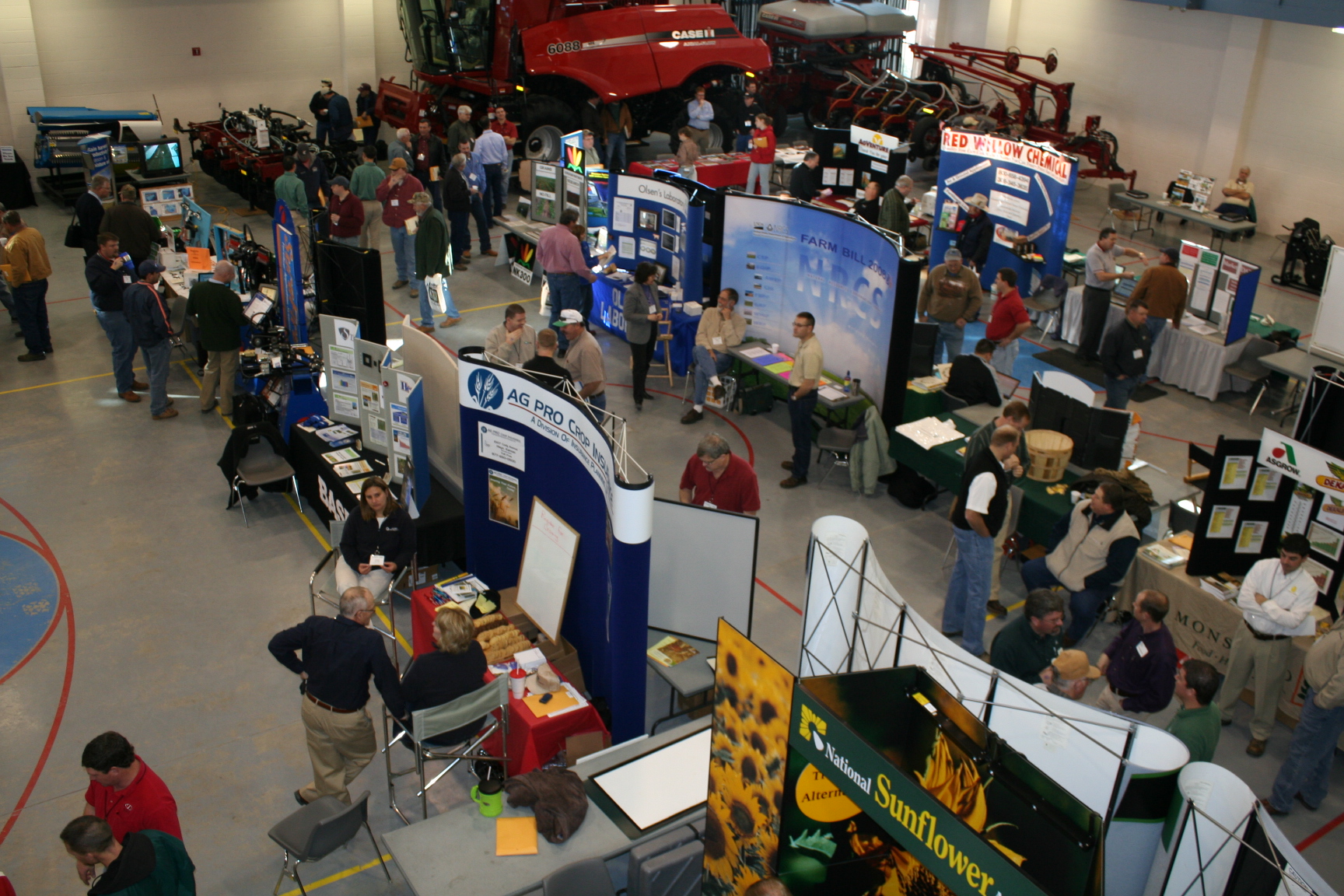
Falk said that the conference is about practical advice for productive farming on the High Plains. “It’s called ‘Cover Your Acres’ so naturally it’s a lot of no-till, conservation tillage issues, how to preserve the moisture we have in this location and make it the most profitable. The event also features an industry expo, which lets producers see the newest items available and visit with company representatives”

Some of the hot topics at this year’s conference were wheat residue management, weed strategies in grain sorghum and pros and cons of UAN with herbicides for wheat. Producers could also learn about advances in breeding technology, marketing strategies and even carbon credit trading.

In addition to the presentations two sessions featured panels of farmers who addressed the topics: things to do before you start to no-till and summer crop plant population.

When the conference is over, all attendees are sent a survey that allows them to evaluate the conference, individual presentations, ask them for ways the conference can be improved, and most importantly asks what topics they would like to see next year. The hot topics indicated on the survey lays the groundwork for next year’s conference.

“This year, weed strategies in grain sorghum was an area farms were really interested in and we get interest in the new technologies, some things farmers just want an update on and also other topics like carbon credit trading; something that’s not discussed a lot and yet it’s very applicable out here,” Falk said. “This conference is very producer driven—they help us pick the sessions, we also have the farmer panels, and the Northwest Kansas Crop Residue Alliance involved which is made up of farmers itself. The conference is very base and very applicable to farmers. We also try to choose speakers who are able to explain things and boil it down to what farmers really need and want to know.”

Farmers attending the conference appreciate the focus the conference puts on production. “They put on a good program and discuss issues that really affect us,” said Bob Martin, a Herndon, KS farmer. “I think it’s really important to have conferences like this and for farmers to continue learning because agriculture is continually changing.”

For those behind the scenes making the conference happen, seeing the end project and feedback from grateful producers makes it a rewarding event to be a part of. “It’s exciting to see farmers, extension specialists, university staff and area people come together for something this large,” Falk said. “It’s fun and exciting to hear what your neighbors are doing, what works for them and what doesn’t and to learn more about what’s going on in terms of research in the area. It’s also a great opportunity for people in research and extension to hear the needs and questions of producers. The conference is really a mingling of ideas and the sharing of information among those people who know and understand agriculture on the High Plains the best.”

With another successful year done, the future of the “Cover Your Acres” conference appears to be bright Falk said. “While we do strive to hold steady and even grow our attendance, the real mission for the conference is to keep it applicable for farmers and to make it worthwhile—that’s really what it’s about.”

Sunday, January 4, 2009

2009 Kansas Agriculture Outlook

Let's Play A Game

“You got to know when to hold 'em, know when to fold 'em, know when to walk away and know when to run.” These well known lyrics of Kenny Rogers, The Gambler don’t just apply to a game of cards anymore.

poker-handAs producers look down the road to 2009 a lot of questions come to mind. Hold out for better prices or take the money and run? The stakes are high and the winnings are uncertain.

But every hand’s a winner and every hand’s a loser – it’s all in how you play your cards. Before laying your chips on the table, consider the inside advice of Kansas agriculture leaders.

Kansas Secretary of Agriculture, Adrian Polansky sees 2009 as a year with challenges that will push for sound decision making. “One area we really need to focus on is risk management,” Polansky said. “For production agriculture the volatility that we’ve seen on the input side whether it’s diesel fuel, fertilizer or other inputs; it appears that we are likely to continue to experience volatility. There will certainly be some market dynamics that we will have to pay attention to in order to be successful.”

Polansky also mentions the uncertainty that lies ahead with a new administration on the federal level. “There is certainly interest in some of the critical appointments, we also have much of the Farm Bill yet to be worked through and there are still many unanswered questions in regard to how the Farm Bill will be delivered, which is very significant to all producers.”

In terms of crop agriculture decisions, Polansky says that policy in terms of biofuels could have significant impact on potential profitability. “For agriculture and the rural economy it’s important that we work towards policy decisions to enhance biofuels and bio-refineries that have positive impact.”

Saturday, October 11, 2008

Harvest Smarter This Fall

9 Ways to Harvest Smarter

A job worth doing is worth doing right — and when it comes to harvesting crops it couldn't be truer.

Before taking to the field this fall, consider these tips from crop consultants, Extension specialists and professional harvesters to make your harvest more efficient and less stressful.

1. ASSESS FIELD HEALTH.

Dwight Koops, Crop Quest western region vice president in Ulysses, KS, recommends that growers evaluate late-season crop health to make sure they harvest fields with potential standability problems first. “Producers will also want to watch for potential stalk rot, corn borer or stem borer problems in soybeans. Be aware of which hybrids dry down more quickly than others,” Koop says.

2.CALIBRATE YIELD MONITORS.

Taking the time and patience to calibrate a yield monitor properly can go a long way when it comes time to make important decisions from your yield data, says Randy Taylor, Extension machinery specialist at Oklahoma State University.

“You want to know how well it's doing at both high and low flow rates, and make sure that the impact plate and moisture sensors are clean before you start,” he says. “The information is extremely valuable, so make sure it's as accurate as possible.”

3. WATCH MOISTURE LEVELS.

“Fishing around for dry corn can cost money, especially at today's fuel prices,” Koops says. “Therefore, taking the time to find out which fields are ready to harvest before all the equipment is brought to the field should help efficiency.” He suggests having a quality moisture tester on hand to avoid hauling excess water to town and taking a dock.

4. EVALUATE FIELD LOSS OFTEN.

Checking behind the combine to determine field loss is important, says Mark Hanna, agricultural and biosystems engineer at Iowa State University. “Many of the losses occur at the head of the machine; making sure that you have things adjusted appropriately is valuable,” he says. “In reasonable operating conditions, loss is approximately 2 kernels/sq. ft., which equals about 1 bu./acre of loss. Combine operators should be striving for that figure — or less.”

Adjustment and clearance on deck plates is important, as well as making sure that the ear savers are present and in good repair to keep ears from bouncing out of the head, Hanna says. Losing entire ears adds up in a hurry.

5. OPTIMIZE MACHINERY WITH ADJUSTMENTS.

“Make the adjustments on your combine one at a time in order to evaluate what's going on,” Hanna says. “Be prepared and allow time to check on settings in the field. Ordinarily, you want to start at the lower speed setting and then adjust up while maintaining grain quality.”


The idea is to get as much crop-on-crop threshing as possible. When the kernels rub against each other to loosen from the cob, it's much more gentle than rubbing against steel.

Crops have the potential of being higher in moisture this year, Hanna says, which puts a premium on machine setup. “Corn cobs are going to be higher in moisture content, as well, and could be spongier,” he adds. “It's going to put a focus on making sure you get the rotor cylinder speed and concave clearance set appropriately.”

6. CAPITALIZE ON TEAMWORK.

Communication between the combine and cart or truck drivers is critical to maximize efficiency, says Lance Johnson, CEO of Johnson Harvesting Inc., Evansville, MN, a business with 48 years of harvesting experience. “The combine driver has to assist the cart driver in their operation. Both operators need to know where they will meet next and the most efficient way to make this happen,” he says.

“The best combine operator is one who knows how to run a grain cart efficiently. Any time you can have a full grain cart at the end of the field where the truck is located makes the cart much more productive and reduces field compaction considerably,” Johnson says.

7. THROTTLE BACK WHEN POSSIBLE.

While your combine has to run wide open, there is opportunity to throttle back your tractor, Taylor says. “If you can, throttle back a bit. You can still get a lot done if you're not overloading the engine and you'll use less fuel. Think about logistics — the location of your grain cart, your truck and how you harvest your fields — so that you spend less idle time with the machines running.”

8. CONSISTENCY TOPS HURRIEDNESS.

One major harvest blunder Johnson notices is that haste often makes waste. “Hastening harvest doesn't make things go faster; in fact that is when problems and accidents occur,” he says. “Any employer who tells an employee to ‘hurry up’ simply made the mistake of not managing his operation efficiently before they got behind schedule. Steady and consistent always wins over fast and furious at the end of the day; it also puts the most bushels in the bin.”

9.TAKE A DEEP BREATH AND RELAX.

Jim Gleason, Crop Quest eastern region vice president in St. John, KS, encourages producers to slow down a little and be safe. “Taking short breaks throughout the day will aid in staying mentally alert while fighting off fatigue,” Gleason says. “It is a proven fact that more accidents happen when you are worn out or distracted. Also, the driver should always be aware of his surroundings and pay special attention when children are in the area.”


Friday, October 3, 2008

Switching it up?

Switchgrass as an alternative crop? Not quite yet.


Cellulosic ethanol production is still in its infancy, with research increasing and only a handful of pilot plants in operation. However, biomass and cellulosic ethanol crops will drive the next wave of agricultural commodities and push producers to re-think crop selection. In time, alternative crops, such as switchgrass, could be a realistic option.


"At this time, it's grown as a cover crop on some CRP land and in some limited amount as a hay crop," says University of Nebraska-Lincoln professor Richard Perrin. "It has received attention as a potential biomass crop for the energy market, but these markets are still in the future."

Switchgrass is a warm-season perennial grass that is native to North America. Perrin says it is competitive with other grass crops in a wide variety of regions, throughout the Great Plains and the Southeast. Because of its native history, it is resistant to many pests and plant diseases and capable of producing high yields with very low applications of fertilizer.

Some fertilization may be necessary to maintain harvestable stands, says Ag Marketing Research Center specialist Dan Burden. The crop is proven to be very tolerant of poor soils, flooding and drought. Switchgrass is also a valuable soil protection cover crop - it binds loose soils and provides valuable wildlife habitat.

However, as a crop, switchgrass requires slightly uncommon management. For optimal output, it is harvested only every other year, rather than annually. Even though it's common in CRP fields, switchgrass harvested for energy generation must be a relative monoculture, meaning derived from primarily a single seed type, rather than part of a mixture of grasses. Once the grass reaches maturity in harvest years, it is swathed and baled, much like other forage crops.

Tuesday, August 5, 2008

Consumers Favor Biodiesel In Survey Results

Survey Shows Consumers Back Farmers and Biodiesel

A recent nationwide survey conducted by the United Soybean Board (USB) and soybean checkoff revealed that U.S. consumers strongly back U.S. soybean farmers and biodiesel.The "National Agriculture Image Survey" indicated 82% of consumers agree foreign oil-producing countries and the high cost of fuel impacting farming and processing, packaging, storing and shipping food are to blame for food price increases, not U.S. farmers.

Other key findings show:
  • 77% of consumers favor the use of biodiesel as a source of energy that can meet our needs in the next 5-10 years.
  • 74% of consumers were more favorable toward biodiesel after hearing it benefits the environment.
  • 70% of consumers were more favorable toward biodiesel after hearing it's a new green industry that creates jobs.
  • 89% of consumers expressed a favorable image of U.S. farmers. Only 7% responded unfavorably and the other 4 % had no opinion.

Friday, July 25, 2008

What's Driving Food Prices? (not ethanol)

Ag Economists Analyze High Commodity And Food Prices


In case you haven't heard, food prices are going up. Go ahead... protest, panic, point fingers. It's that evil ethanol industry that's doing this afterall, how dare they use corn to make fuel, taking away from the supply and making the grocery bill go up.

Recent studies of Purdue University ag economists show that in fact the food prices are drven by a combination of factors... not only ethanol. High oil prices, the weak dollar, world production and consumption trends all add a little 'push' to the price. But that's a side of the story less often mentioned.

The following is a excerpt from the press release from Purdue University about the findings:

--- In a Farm Foundation commissioned report, the Purdue economists - Phil Abbott, Chris Hurt and Wally Tyner - highlight key factors gleaned from examining 25 recent studies plus their own analysis. Their conclusion: a complex combination of factors is fueling agricultural commodity price increases and rising food costs.

 Tyner, an expert on energy and policy issues, said the price of oil is an important factor that has increased the demand for biofuels. "About $3 of the corn price increase is due to the higher oil price and $1 to the ethanol subsidy," he said.

 As high oil prices spur demand for biofuels, the increased corn production stimulates demand for fertilizer, diesel, propane and other agricultural inputs. Prices for these inputs have also risen due to the "demand pull" from more corn being produced and subsequently the "cost push" due to the fact that petroleum products are key ingredients in many of these inputs.

Thursday, July 17, 2008

Grain Bin Safety


Stay Safe Handling Grain 
Ways to avoid fatal grain storage accidents this fall.

Plant it. Harvest it. Store it. With wild market prices and high demand for ethanol, an increasing number of farmers will be storing. Whether you're a grain-storing greenhorn or an experienced operator; knowing how to safely manage grain is essential.

While it takes an entire growing season to produce the millions of bushels of grain harvested each year, it takes fewer than five seconds for a person to become helplessly trapped in flowing grain and fewer than 30 seconds to be fully engulfed, says Kerri Ebert, Kansas State University Extension assistant of agricultural safety. Grain-handling hazards can, however, be reduced if you follow the appropriate safety rules.

According to the National Institute for Occupational Health and Safety, roughly 516 workers die a year doing farm work in the U.S. Of those incidents, flowing grain entrapments alone account for an average of 12 deaths each year. All of the grain in storage is not worth the life of one farmer-- and by following basic guidelines, grain-handling accidents are preventable.

Because stored grain can trap you in seconds, there's very limited time to call for help. Ebert recommends never working alone when moving grain and staying out of bins, grain wagons and trucks when unloading.

When emptying bins, a person standing on top can become sucked into the grain when the unloading auger is turned on. "The auger typically pulls down from the top center of the grain pile creating a funnel-shaped indention," Ebert says. "As grain flows down the victim is pulled down too, even as the remaining grain flows down around and on top of the victim, until the person becomes lodged in the floor auger."

Looks can be deceiving when emptying a bin of poor quality grain too. Spoiled grain will crust over on the surface and look solid while a cavity develops below. It can also cake in large vertical masses along the side of the bin. Use caution during these situations and try to break up crusts and masses from outside the bin.

Ebert also says that people underestimate the weight and force of grain. "Most people can't pull another person out of a grain bin with a rope, even if standing next to the entrapped person," she says. "Once a person becomes entrapped, it takes much more force than you expect to pull them out. For example, when an adult is submerged to the waist in grain, it takes 300 lbs. of pulling force to extract them."

Equipment noise can block commands or cries for assistance when operating a grain bin. Make sure someone knows where you are and plan a method of communication before entering the bin or hopper. Use a cell phone, walkie-talkie, or hand signals.

If you must enter a full bin of grain, wear a safety harness with a tether or a rope tied off so it can't slip from your helper's hands. A minimum of two people should be at the end of the rope who are strong enough to pull the trapped person out or at a minimum keep their head and chest out of the grain. In an emergency one helper can call for assistance.

Never enter a grain bin, cart or hopper car when it's being unloaded. Turn off, lock and tag power to the auger before entering so that no one else can start the auger while you are inside or an automatic timer won't start the auger. Use a lockout and tag out system to ensure your safety.

When someone does become submerged in an enclosed grain bin, the most effective emergency rescue step is to cut four to eight large holes all around the base of the bin approximately five feet from the ground, Ebert says. This method removes grain in the shortest time possible and time is of the essence because of the potential for the victim to suffocate.

Also, be aware of the air quality around stored grain. Grain dust can be a mixture of particles of grain, soil, plant material, fungi, bacteria, chemical residue and the excreta of insects, rodents and birds. Spoiled grain is especially contaminated with dust and bacteria. These dusts can affect the respiratory tract in a variety of ways including inflammation, asthma, pulmonary disease, Toxic Organic Dust Syndrome and Farmer's Lung.

When grain is stored wet, it ferments and produces the colorless, odorless gas carbon dioxide (CO2). If working in this environment, CO2 can enter your bloodstream and slow breathing. Spoiled grain can also produce mold spores that become airborne when disturbed.

To help reduce reactions, Ebert suggests wearing adequate protective masks and open manholes to increase air circulation.

Wednesday, July 9, 2008

Soybean Aphid Management

Tips For Soybean Aphid Management


§         Begin scouting soybean fields once or twice a week in late June to early July. Check 20-30 plants/field. Aphids are most likely to concentrate at the very top of the plant early in the season, and will move onto stems and within the canopy as populations grow and/or the plant reaches mid to late reproductive stages. As the season progresses, aphid numbers can change rapidly (populations can double in two to three days).

§         The current recommended threshold for late vegetative through R5 stage soybeans is 250 aphids/plant (field average) with 80% of the plants infested and populations increasing. Depending on economic conditions, this gives you about five to seven days to schedule treatment before populations reach damaging levels. (If populations do not increase during these seven days, you may be able to eliminate or delay treatment.) Determining if the aphid population is actively increasing requires several visits to the field. Factors favorable for aphid increase are relatively cool temps, plant stress (particularly drought), and lack of natural enemies.

§         Look for the presence of aphid natural enemies such as lady beetles, minute pirate bugs, and other insect predators. Aphid “mummies” (light brown, swollen aphids) indicate the presence of parasitoids. These predators and parasitoids may keep low or moderate aphid populations in check (under 200 aphids/plant). You can often find soybean aphids by examining plants where lady beetles are observed.

§         Look for the presence of winged aphids. If the majority of aphids are winged or developing wings, the aphids may soon leave the field and treatment can be avoided.

§         If plants are covered with honeydew or sooty mold, or are stunted, an insecticide treatment may still be of value, but the optimum time of treatment is past.

§         If fields are treated, leave an untreated test strip to compare against sprayed sections. This also provides a refuge for beneficial insects.

§         Good insecticide coverage and penetration is required for optimal control of soybean aphid, as many aphids feed on the undersides of the leaves and within the canopy. Use high water volume and pressure. Aerial application works well when high water volume is used (5 gal./acre recommended).

§         Several insecticides are labeled for the soybean aphid. A list of registered insecticides, rates, preharvest intervals, and grazing restrictions can be found at the UNL Department of Entomology Web site, http://entomology.unl.edu/instabls/soyaphid.htm. Pyrethroids have a relatively long residual. Chlorpyrifos has a fuming action and may work well in heavy canopies or at high temperatures. Dimethoate is least effective.

§         Spraying flowering soybean poses a threat to honey bees. Inform treatment plans to nearby beekeepers and follow precautions to minimize honeybee kills. When there is concern about honeybees, pyrethroids are the better insecticide choice.

§         It is generally not recommend to apply an insecticide at glyphosate application. In Nebraska this is usually before the aphids reach damaging levels, or are even in the field. Insecticide treatment at this time would simply rid the field of natural enemies. In addition, application methods for herbicides (e.g. lower pressures) are not optimal for good insecticide efficacy.

§         If soybean rust is present and being sprayed when soybean aphid thresholds also are met, a fungicide/insecticide tank mix should be effective because application methods for both require high water pressure for adequate penetration and coverage.


More information can be found at entomology.unl.edu or through your local UNL Extension office.

Friday, June 27, 2008

More than food & fuel

Getting More From The Kernel 


We often think of corn as a simple commodity, limited to either food or fuel. However, corn can be processed to utilize any or all of its four major components -- starch, protein, oil and fiber -- in thousands of applications, products and alternative uses.

Corn processing continues to find new uses, which benefit consumers around the world and create new markets for producers.

“As corn prices go up, there becomes increased interest in getting more out of it,” says Larry Johnson, director of the Center for Crop Utilization and Research at Iowa State University. Johnson says that while high corn prices have not had an effect on the amount of research being conducted, it has affected the focus.
“We believe you can produce both food and fuel from corn,” Johnson says. “Edible oil, high quality feed, stillage conversion, bran conversion, all of these things, we’re trying to get more out of corn than we used to get.”

Getting more out of corn is something that is the specialty of NatureWorks LLC. Using biopolymer technology, the company manufactures a plastic called polyactide (PLA) and Ingeo fibers, which are licensed to other companies that provide consumer goods. Because these products are corn-made, they use up to 68% less fossil fuel energy than traditional plastics and can break down into compost.

“Consumers are now brutally aware of how oil-based our economy is, not just in terms of what goes into our gas tank, but the products we buy,” says Steve Davies, global marketing director of NatureWorks LLC. “The consumers now get that we need better options. They are driving huge demands for these products today because they are so much more aware of the impact of what they buy and it’s influence on the environment.”

NatureWorks PLA and Ingeo can be found in a variety of products such as packing materials, carpet, hygiene products, fresh food packaging, cleaners, disposable tableware and apparel. Other products becoming more common included plastic gift cards, weed-blocking landscape covering, durable plastic electronic housings and baby diapers.

“Consumer reaction is typically surprised but positive,” Davies says. “Consumers have the idea that doing something good for the environment means giving up something. It’s viewed as something that wouldn’t work as well or look as good, and we’ve taken a lot of trouble to work with downstream manufacturers to make sure the product performs well, looks good and is good for the environment.”

While the acceptance and growth of these corn-based products has been impressive, Davies says the industry has more development to come. “NatureWorks LLC started in 2003 the world’s first and largest bio-plastic facility, and yet it’s still tiny in terms of the global plastic and fiber market,” Davies says. “What we see going forward is PLA, Ingeo and other bio-plastics becoming a fact of life and the norm.”


This growing market which offers new uses for corn will also benefit producers, says Nathan Fields, director of research and business development for the National Corn Growers Association (NCGA). “If we can diversify the use of corn it will create more marketing opportunities and ultimately help corn growers,” Fields says. “Technology and research in terms of processing is continuously developing, there are a lot of promising applications to be excited about.”

Interested in these new value-added corn products? Check out some of the merchandise on retail shelves that started in a corn field.

-“We milk the cows and grow the bottles” is the motto of Naturally Iowa, Inc. The company packages its certified organic dairy products in PLA containers through a partnership with NatureWorks LLC. For more information visit www.naturallyiowa.com or call 712-542-MILK.

-Mohawk Industries and DuPont’s SmartStrand carpeting is made of readily available agricultural materials, including corn. Stylish, durable and environmentally smart, you can enjoy your corn crop year round right in your living room. For more information visit www.mohawkcarpet.com/carpeting/smartstrandor call 800-2MOHAWK.


-Looking for a unique company promotional item? Corn-based biodegradable plastic mugs, pens, letter openers, rulers and golf tees are available at www.cornmug.com, or call 425-681-2460.

-Get a good night’s sleep with Ingeo fiber pillows and comforters. Available at home stores, these bedding goods offer superior performance and insulation, luxurious comfort, lasting, springy loft and exceptional durability. Visit www.target.com, www.cozywinters.com, or www.bedbathandbeyond.com for more information.

-Look good and feel good by wearing an Ingeo shirt from EcoWear USA of Eden Prairie, MN.  Available in various styles and colors these wrinkle-free, easy care durable shirts will surely make a fashion statement. Furthermore, at the end of its useful life, your Ingeo clothing is fully recyclable. For more information visit www.ecowearusa.com.

-Sam’s Club and Wal-Mart Super Centers now offer PLA packaging on fresh cut fruit, herbs, strawberries, Brussels sprouts and bakery products. Research indicated that with this change to packaging made from corn will save the equivalent of 800,000 gallons of gasoline and reduce more than 11 million lbs. of greenhouse gas emissions.

For additional listings of corn products made using NatureWorks LLC Ingeo fiber and PLA, visit www.ingeofibers.com and www.natureworksllc.com. There you can find more information about the variety of products and where to buy them.

For a complete listing of all products made with corn, visit the NCGA product search page at http://www.ncga.com/research/comm_dev_center/index_PG.asp.

Friday, June 13, 2008

Biofuel Battle

The hot button issue of biofules continue to make headlines across the nation as power players from all industries begin the finger-pointing, fact throwing game. The following is a fact sheet release by the USDA in a joint effort with the DOE.

 
Fact Sheet Gas Prices and Oil Consumption Would Increase Without Biofuels

June 11, 2008

Secretary of Energy Samuel W. Bodman and Secretary of Agriculture Edward T. Schafer sent a letter on June 11, 2008 to Senator Jeff Bingaman addressing a number of questions related to biofuels, food, and gasoline and diesel prices. The letter is available at http://www.energy.gov Without Biofuels, Gas Prices Would Increase $.20 to $.35 per Gallon.The U.S. Department of Energy (DOE) estimates that gasoline prices would be between 20 cents to 35 cents per gallon higher without ethanol1, a first-generation biofuel.
For a typical household, that means saving about $150 to $300 per year. For the U.S. overall, this saves gas expenditures of $28 billion to $49 billion based on annual gasoline consumption of roughly 140 billion gallons. Ethanol use has exceeded the requirements of the Renewable Fuel Standard (RFS), established in the Energy Policy Act of 2005, demonstrating that refiners and gasoline marketers have an economic advantage to use more ethanol than is required by law.

Biofuels are Reducing America's Dependence on Oil.
Without biofuels, DOE estimates that the United States would have to use 7.2 billion more gallons of gasoline in 2008 in order to maintain current levels of travel (a 5 percent increase). This increased demand for gasoline would drive up the price Americans pay at the pump due to basic supply and demand.

Biofuels are Reducing Greenhouse Gas Emissions.DOE scientists found that corn ethanol from the U.S. reduced greenhouse gas emission 19 percent compared with gasoline, when the full "life cycle" of the fuel is considered – from growing it to producing the fuel and burning it. DOE scientists estimate that 13 million tons of greenhouse gases were avoided in 2007 due to biofuels production and use. The next generation of biofuels—cellulosic—made from switchgrass, corn stover, wood chips and other non-food sources promises even more significant reductions in greenhouse gas emissions than corn-based ethanol – reductions of more than 86 percent compared with gasoline.

[1] This estimate relies on data on the current price difference between ethanol and gasoline and the elasticity of supply for petroleum. Consequently, a range is presented.

Today's Biofuels Account for Only a Small Percentage of the Increase in Global Food Prices.
Other factors are responsible for the majority of the increase in global food prices:
Higher oil and gas prices leading to increased costs of fertilizer, harvest, and transportation; Increased demand as developing countries grow and people improve their diets; Two years of bad weather and drought leading to poor harvests in parts of the world; Export restrictions imposed by some countries.

Future Biofuels Will Alleviate Much of the Concern about Competition Between Food and Fuel.Cellulosic biofuel feedstocks can be produced on land not suitable for crops or it can be collected from forest residues. The Administration has announced more than $1 billion for the research, development, and demonstration of new biofuels technology, with a special focus on cellulosic biofuels. Funding supports: Bioenergy Research Centers where scientists work together to make the conversion of plant fiber to fuel more cost-effective and efficient.


Wednesday, June 11, 2008

Why agricultural communications?

Since I was a senior in high school I knew exactly what field I wanted my future career to be in. However, I often found that when I shared my plans with others I was faced with a blank stare followed by the typical question -- So what is agricultural communications?

It seems somewhat self-explanatory to me, but I will upon request provide a complete definition of what it entails.

This article by TIME titled The Clean Energy Scam is an example of why it really is necessary to have agricultural communicators integrated into the mass media market.

The article presents the idea that corn ethanol is not only causing higher food prices, but progressing the deforestation of the Amazon rain forest as well. The writer uses inaccurate information and fails to cover all sides of the issue.

The National Corn Growers Association addressed the article with a response. However,TIME readers will most likely remain unaware of the true facts.


Thursday, April 24, 2008

Efficient spraying- more for your money

Applying efficiency to your spraying routine

When is comes to spraying, the chemical is only as effective as the application process itself. With a better knowledge of equipment and product, producers can increase spraying efficiency.

Robert Klein, University of Nebraska- Lincoln extension cropping systems specialist, has been offering producers advice through workshops, which include more than simply sprayer calibration. “Calibration is very important, but before we start spraying we take a pressure gage and check the pressure on the boom,” Klein said. “This is critical because often it’s found that there is not even pressure throughout the boom. If the pressure is not even across the boom, calibration is a waste of time.” Klein also recommends checking the pressure gauge in the cab to determine if there is a difference, either high or lower in the boom.

Calibration of sprayers includes speed, spacing and nozzle flow rate. Robert Wolf, K-State extension application technology specialist, stresses the importance of setting up a sprayer properly. “Producers need to be actually putting out the amount of chemical that they think they are in order to get effective coverage,” Wolf said. “A lot of times a farmer or commercial applicator is going through the field and paying attention to the rate controller and may not have a good feel for what’s going on in the droplet situation.”

Spray nozzle tip selection is a topic producers should become familiar with. “It’s important to know where various nozzles should be used and what pressure it should be used with,” Klein said. “Different nozzle materials offer different advantages - brass, plastic, stainless steel – you really have to know what your purpose is and what type of droplets are desired.”

A concern is that the nozzles are not putting out the correct amount, or that there is a pattern problem and coverage might not happen as accurately as it should, Wolf said. That’s really a critical issue when you’re trying to get coverage on the targeted surface. “Some producers in Kansas are operating on the edge with low volume of application, and with lower volume of application the more risk you have because it’s smaller droplets and less material being put out,” Wolf said. “If it’s a hot, dry windy day the coverage lessens, and that is something to keep in mind.”

Wolf said it’s important to get the sprayer set up to deliver the right size of droplets. “Applicators are getting more and more focused on that because we are learning that certain types of weed targets are going to require different kinds of coverage and droplet size aspects than others, and the sprayer must be set up for it,” Wolf said. “That is going to require applicators to have a pretty good knowledge on the type of nozzle they are using.”

Klein and Wolf both exhibit a nozzle demonstration at their various spraying workshops and seminars. By using a spray table and strobe light to show the various particle sizes and nozzle types, producers are able to see side-by-side the advantages and disadvantages of each nozzle. “We try to illustrate what the different nozzle technologies will do through our demonstrations,” Klein said. “It gives the operator a visual picture of how the nozzle will perform and after seeing the difference producers understand why it’s so important.”

Chemical companies are starting to do more research to identify what droplet sizes might be in order for farmers to better set-up the sprayers, Wolf said. Also, nozzle manufactures are providing data to the farmers, that information can be used to select the right nozzle for the job. “Chemical labels are also starting to address the droplet size issue,” Wolf said. “The American Society of Agricultural and Biological Engineers has adopted a standard which the EPA is promoting and chemical companies are starting to use. That standard specifies a droplet size spectrum broken down into six categories; very fine, fine, medium, coarse, very coarse and extra coarse.”

Other technologies such as auto-steer and boom control provide opportunity for more efficient application. “Boom height control can be used to maintain a uniform height across the field,” Wolf said. “Boom swath control with GPS and a rate controller system keeps track of areas that are sprayed and not sprayed. The boom will turn on and off in segments so that applicators don’t double spray or miss spots.”

Wolf has noticed that more farmers in the Midwest are doing their own spraying than in previous years. “With the technology changing everyday and the newer nozzles it’s very important that we have the various programs through extension service to get information to applicators,” Wolf said. “From my experience producers are very interested in learning more about the topic, they will come to the meetings and ask good questions - this education something that’s needed.”


pH testing on the go

Technology makes variable-rate liming easier


Maintaining suitable soil pH has long been a concern and headache for many crop producers. Conventional soil sampling is laborious and costly - especially true when farming in a site-specific manner. However, new technology makes variable-rate lime application affordable and practical with on-the-go soil pH testing.

“Variable rate liming is one of the most profitable and popular practices in site-specific crop management,” says Viacheslav Adamchuk, precision agriculture engineer at the University of Nebraska - Lincoln. “In addition to knowing acidic field areas, having knowledge of areas with alkaline soil conditions (high pH) can be useful to avoid lime application in these areas and also aid in the selection of crop varieties tolerant to problems associated with high pH.”

Currently, most variable rate lime prescription maps are gener­ated based on soil samples collected manually and analyzed in laboratory conditions. These samples are usually obtained with a 2.5-acre sampling frequency. With on-the-go testing, samples are taken at a greater density and at a relatively same or lower cost. Adamchuk says that the economic benefits of variable liming through advanced pH maps can range between $5 and $15 per acre, with significant environmental benefits as well.

In 2004 Veris Technologies of Salina, Kan. began marketing the first on-the-go pH mapping device- the Mobile Sensor Platform (MSP) pH Manager.

People see it work and say, ‘It’s so simple anybody could have thought of that’,” says Eric Lund of Veris. “The fact that the unit is one moving part makes it jaw dropping simple.” Lund explains the main concept of design is a cutting shoe that goes beneath the ground allowing soil to flow through horizontally creating a soil core. The shoe is then picked up hydraulically and the soil is held against two pH electrodes for 10 seconds while a reading is stabilized. During each cycle the shoe is cleaned off by a scraper and the pH electrodes are washed off with water nozzles. The sampling process is controlled with an external electric control module and the pH data is recorded.

Lund says the system is predominately used in places where people apply a lot of lime. “pH is really an issue in the eastern Midwest as well as other pocketed areas. Producers that spend the money to put on lime need to determine the pH better than what they have been.” Lund also says that the majority of pH Manager sales are to Co-op’s, agricultural retailers and large farmers. Approximately one third of Veris sales are over seas.

Steve Kramer, technology manager for Servi-Tech in Stromsburg, Neb. has been using the pH Manager since 2003 and sees the benefits the technology has to offer.

“It takes a lot of variability out of the picture when you’re trying to record pH,” Kramer says. “In fields that have pH issues you only want to address the areas that need it. With the price of lime you want be as efficient as possible - it’s too expensive of an input to go out there and put two tons on the whole field. It makes more sense to put it where you need it or to not put it where you don’t need it.”

The greatest advantage of on-the-go testing is variation in sampling density and reduced labor costs. Lund says that lime requirements simply vary too much within a field to allow the computer to fill in the gaps between a handful of samples.

Using grid sampling the pH at each point is determined in laboratory testing, which is better than on-the-go readings,” Lund says. “With grid sampling the space between the points is then automatically filled in. However, there’s more area of the field between the points than there is at the points.”

When grid sample sites are overlaid on a pH Manager map, it’s evident that there is more variability than grid samples will be able to capture, Lund says. “Software may contour the grid spots into a pretty map, but it can’t accurately map what wasn’t measured.”

After a pH map is made using on-the-go testing Kramer and other consultants use the results as well as buffer pH and soil texture information to generate lime recommendations. Kramer says this helps the producer put the right amount of lime where it needs to go. “With the Veris map producers typically use about the same amount of lime. The difference is that they’ll know to put less where they don’t need it and more where they do.”

K-State agronomist, Scott Staggenborg, says that on-the-go pH testing can help producers make more informed management decisions. “When researchers began looking at variable rate inputs in the early 2000’s it became obvious that lime would be significant because of the cost of the material and the fact that it is spatially oriented,” Staggenborg says. “Grid sampling was just not dense enough to make the decisions that needed to be made. The real-time sensors make the most sense and the biggest advantage is that you get a very dense data set.”

Certain crops are more susceptible to suffering from lime deficiencies Staggenborg says Soybeans, alfalfa and wheat are crops that can experience harmful lime deficiencies. In legume crops, low pH inhibits the bacteria necessary to starting the nitrogen fixation process which reduces nodulation. Wheat under low pH can suffer from toxicities, most notable being aluminum toxicity. This means that having soil with suitable pH can be very important and fixing pH problem areas more accurately only makes sense.

Is it really possible to test soil with out the laboratory? As with any new technology, some may be skeptical of on-the-go pH testing and the accuracy it provides. “Not only is it being done in a field, its being done on a piece of equipment that is bouncing and moving along at about 4-8 mph.” Staggenborg says. “The trade off is while the samples may not be as accurate as those from a laboratory, we get them at a more dense rate and we get them right now.” Staggenborg also says that it doesn’t necessarily have to be completely accurate because producers are putting on tons of material. Lime applications are not as finely tuned as other elements and on-the-go testing is accurate enough to pick up substantial variations. Results from field, static and lab tests show that the on-the-go method produces pH measurements that are highly correlated with laboratory analysis of soil pH.

While the system may not be flawless, the technology is by far a step up from other forms of pH sampling. “Pinpoint lime application is the main benefit; you know what your pH is,” Lund says. “You know you need some lime here, a little here and a lot over there. Lime is expensive, with this type of mapping it easier to choose which areas to apply lime and help farmers make better management calls.”