Showing posts with label Technology. Show all posts

Thursday, February 25, 2010

Not your father's cab

New tractors feature tantalizing creature comforts

The future of farming was displayed in full grandeur at the 45th National Farm Machinery Show in Louisville, KY this month. As in the years before, producers dispersed among rows of glistening machinery to catch of glimpse of what’s new. But it’s not just about being bigger or more powerful these days—it’s also about the operator experience.

Helping operators work more comfortably and productively has become an industry wide trend, and the results are visible especially in today’s tractors. Changes in cab design are much more than an extra cup holder or wider seat; every detail is designed to provide superior comfort, convenience and control throughout the workday and best suit the needs of modern producers.

“It’s always exciting to see what new features they come up with for tractors,” says Iowa farmer, Ray Hinkley. “When I first started driving tractor 30 some years ago you never thought about things like comfy seats or controls—it was all about the work, about horse power and pulling equipment.”

For those who have endured the past generations of tractor cabs like Hinkley, the improved designs are a welcome feature. “I remember what is was like to bounce around in a loud tractor cab all day, it would just wear your body down,” Hinkley says. “But with these new tractors and better cabs it’s quiet and comfortable-- some days it hardly feels like work at all.”

Climb into a John Deere 8RT Series tractor and try out the CommandView II Cab. It offers a roomy work environment, easy-to-use monitors and controls and better visibility. The seat is built using cut-and-sew cushion construction, adjustable backrest angle, and lumbar support controls for increased operator comfort. Many of the features and controls that were on the right-hand console have been integrated into the CommandARM. The controls and CommandCenter now follow the operator as the seat swivels for added comfort. The 7-in color display is divided into three regions and can be partially configured by the operator to monitor three tractor functions of their choice. Overall, the series offers 10% more cab volume, 7% more glass area and four times more storage area over the previous CommandView cab.

Relaxing into something red from the Case IH Magnum series is easy with the Surveyor cab. Take in the view with panoramic curved glass; comfortable, positive response seat; and ergonomic armrest controls. The right-hand controls in all Magnum models include: Speed, direction, hydraulics, hitch, PTO and end-of-row switch all within reach, integrated gear/throttle control handle, and an optional electronic joystick. With six power outlets, ample storage, and a large workstation to the left of the seat to holds papers, a laptop computer or other items it could be a functional mobile office.

For those who prefer the blue hue, New Holland’s T7000 tractor offers plenty of creature comforts. The ultra-quiet, high-visibility cab boasts 63 square feet of glass providing an unobstructed view in every direction. A high-visibility roof panel also provides an upward view for loader work. The new Sidewinder II armrest electronically slides forward or back to suit each operator and includes a standard multi-function controller, throttle and electronic draft controls that travel with the seat. Additional features for the cab include a new cool-box option for keeping beverages and snacks chilled and a standard enhanced keypad for tracking engine hours, distance traveled and more.

The AGCO DT Series tractors also stepped up to the plate with a totally new cab design. The 4-post cab has a 28% increase in cab space, giving it the largest cab in its size class. It features more room for the person in the instructor’s seat, a redesigned armrest-mounted console that puts all key functions where they are most convenient and one of the quietest interior sound ratings in the industry at just 71 decibels. With a larger field cooler and a field office that includes a cell phone holder and outlet this cab is ready for hours of work.

Regardless of the size, shape or color it’s obvious that tractor cabs have come a long way over the years. “If it wasn’t for the better equipment and new cabs, I couldn’t keep going like I am,” Hinkley says. “Farming is hard work but the new improvements make it much easier.”

Wednesday, January 20, 2010

Telling the agriculture story in the social media age

Keeping Up


Facebook, Twitter, YouTube, MySpace, LinkedIn.

Chances are you've at least heard of these terms. They are all part of the rapidly growing social media network - the set of free online tools that allow the building of relationships between individuals sharing interests, information and ideas.

But why should farmers and ranchers care? Why should producers take the time to log on to social media? It's pretty simple: social networking sites offer the opportunity to reach millions of people with just a few clicks. These are tools that aren't just for teenagers or the tech savvy anymore. Social media has become mainstream - a place where the agriculture voice is not always heard.

"Social media offers us the ability to reach the 99 percent of the population that isn't in production agriculture," said Debbie Borg, chairman of the Nebraska Soybean Association who farms with her family near Allen, Neb. "When people understand why we do what we do, they are okay with it. But if they don't know, then all they hear is the other side."

Borg joined Twitter in March 2009 (user name @iamafarmer2) she's on Facebook and has a blog (www.ouragstory.blogspot.com). She Tweets about the daily happenings on the farm to followers from around the country.

"The consumer is so removed from the farmer that there is a growing awareness of wanting to know more about their food," Borg said. "It's become very obvious that we in agriculture must start talking with those outside our neighborhoods. Social media is a great way to reach more people with things we do on the farm everyday. If I can educate just one person a day, that's one more person who knows the truth."


It might start with educating just one person, but the numbers and breadth of social media are impressive and still growing.

Facebook, the popular social networking Web site, allows friends, classmates, colleagues and others to connect and share photos, messages and information about their lives with people in their network. It has more than 350 million users, and if it were a country, it would be the fourth largest in the world, according to Nielsen Co.

The newcomer in social networks, Twitter, is a cross between text messaging and blogging, where users are prompted to answer the question, "What are you doing?" in 140 characters or less. The site has grown 200 percent in the past year and estimates more than 26 million users in 2010.

Video sharing Web site YouTube is now the second largest search engine in the world and uploads 13 hours of video every minute of every day.

All of these networks and others can be linked together and even carried with you on your iPhone, BlackBerry or Driod to keep you constantly connected and updated.

"Social media allows us the opportunity to tell our story from the comfort of our own operations instead of having to leave our businesses and travel to speak to the public," said Lincolnville, Kan., rancher, Kim Harms. "In essence, social media outlets allow us to invite the public into our lives, homes, families and businesses to see the truth - not just hear others opinions."

Tuesday, January 5, 2010

Return to the Ranch

Cashing in on individual cattle management


You cannot manage what you cannot measure – the simple principle of the Decatur Beef Alliance which aims to get progressive producers out of the commodity business and into the value-added beef business.

Since 1971 Decatur County Feedyard, just North of Oberlin, Kan, has been in the commercial feeding business under the leadership of owner Warren Weibert. The feedyard has a one-time capacity of 40,000 and is turned over about 1.75 times a year. The focus is on retained ownership customers and improving long-term profitability through information. Decatur County Feedyard began sorting cattle by ultrasound in 1987, and was the first commercial feedlot to sort cattle with a video scanner.

In 1994 the Decatur Beef Alliance was established and the facility invested in Micro beef Technologies’ ACCU-TRAC Electronic Cattle Management System as part of a Total Quality Management approach to beef production.

The alliance enables producers to maximize profit from the genetics bred into the cattle and strengthen the relationship between ranchers, feeders and packers.  The program is rooted in the management principle that beef quality and consistency can’t improve, nor can profits, unless the information necessary for genetic selection is passed back to the producer.

“We focus on individual management,” says Director of Supply Development, Dan Dorn. “Our ultimate goal is to better the return to the ranch and increase the ranchers’ profitability.”

Dorn works with more than 200 regular customers spread across the U.S. from Florida to Hawaii, primarily involved with retained ownership. He works closely with cow/calf producers on advising, reviewing and offering recommendations for genetics and marketing.

According to Decatur County Feedyard results, individual management in the feedyard produces an average $15 per head performance advantage over group management. Timely marketing on a value-based grid system adds another $5 to $10 per head advantage. The greatest potential for higher profits however, is back at the ranch where genetic improvements based on individual performance and carcass data can bring another $50 per head profit. The wealth of individual performance data provides the producer the opportunity for another level of herd management.

Sunday, August 9, 2009

Irrigation Face Off

Center pivot or subsurface drip?


Farmers are professional decision makers. In every aspect of their work they are faced with choices and options to consider, even when it comes to irrigation systems.

Subsurface drip irrigation or SDI, a low-pressure, high efficiency irrigation system that uses buried drip tubes or drip tape to meet crop water needs is one option. SDI technologies have been a part of irrigated agriculture since the 1960s; with the technology advancing rapidly in the last two decades.

But how does an SDI system stack up to the more popular center pivots that roll over many of the irrigated acres in the Midwest?

“SDI systems are generally thought to be at least as efficient in terms of irrigation water use as center pivot irrigation systems, primarily because they avoid the evaporative losses that occur from exposing irrigation water on the soil surface and in the open above ground environment,” said K-State Extension Specialist, Daniel O'Brien.  “At K-State we have used conservative estimates of 10-20% water savings efficiency with SDI compared to center pivot irrigation.  In field situations were irrigation water availability is not limited, these efficiency gains may not be that important.  But where irrigation water supplies are more limited, 10-20% efficiency gains in irrigation water use could be extremely important and beneficial to an agricultural producer.”

It’s the system’s efficiency that attracted producers Jim and Jeff Reinert, a father/son farming duo from Ensign, KS. Their farm includes two separate SDI systems both 60 acres each, one with 30 inch tape the other with 60 inch.

“The thing you ultimately look for is the value of water,” Jim said.  “As water becomes more and more important to us, it’s something we need to do a better job of conserving.  We also want to be more efficient with our water allocations in relation to our acres. If we can maximize the productivity with a drip tape system to better use our water—that adds a value that is extremely important. Everything we can do to conserve water can only work in our benefit. I’ve been irrigating for the better part of 50 years and I hope my son has that same capability.

Wednesday, February 4, 2009

Lean, Mean, No-Tilling Machines

Producers gear up for planting season with proper equipment


You carefully plan your crop rotations, shop for seed varieties, budget wisely for chemicals and analyze the markets. But nothing is more important than getting your no-till crop off to the right start with proper seeding.


no-till-equipment-015Attaining good stands in no-till requires hard working planters and drills that can handle residue without the hassle of plugging, penetrate the soil to the desired seeding depth, establish proper seed-to-soil contact and effectively close the seed-vee.


“Having the right equipment, functioning properly is one of the most important factors in no-till,” says Sterling, KS no-till farmer, Lee Scheufler. “It may seem expensive or tedious—but it’s time and money well invested.”

Scheufler and his wife, Margaret, began no-till farming in 1996 after seeing success with on-farm trials. “We decided to gradually switch from conventional tillage to no-till over several years, but in terms of equipment and mindset it was difficult to do both. By 2002 we were 100% no-till with a capital ‘N’ we do as little to disturb the soil as possible.”

The Scheufler’s do that by keeping it simple, yet being open minded. “As far as equipment—we don’t do anything exotic, it doesn’t have to be fancy to get the job done. We have always been the type to test things for ourselves before completely adopting it.”
Keeping with the idea of “try before you buy” the Scheufler’s also do custom work, making it possible for other producers in the area to try no-till without long term commitment. “It’s really about finding what works best for you,” Scheufler said. “It’s not about what everyone else is doing, or having the biggest or best —but about what fits your farm and operation.”

By evaluating the strengths and weaknesses of any piece of planting equipment and making few (if any) adjustments— many available planters and drills can be no-till worthy,, said University of Nebraska-Lincoln Extension Engineer, Paul Jasa.


With appropriate weight, down pressure and adjustments, most current planters and drills will perform well in no-till conditions, Jasa said. A little time spent in the early spring will help avoid headaches and delays later during the planting season, so consider your equipment needs now.

Saturday, January 24, 2009

Producers gain insight at “Cover Your Acres” conference


"The only person who is educated is the one who has learned how to learn and change." -- Carl Rogers


cover-your-acres-005

Step into any local Midwest coffee shop or small town cafĂ© some morning and you will likely find a couple farmers in deep conversation; exchanging news and ideas. While the stories and wisdom shared in a scenario like this may not always be completely accurate—it’s one of the most basic forms of producer interaction and education.

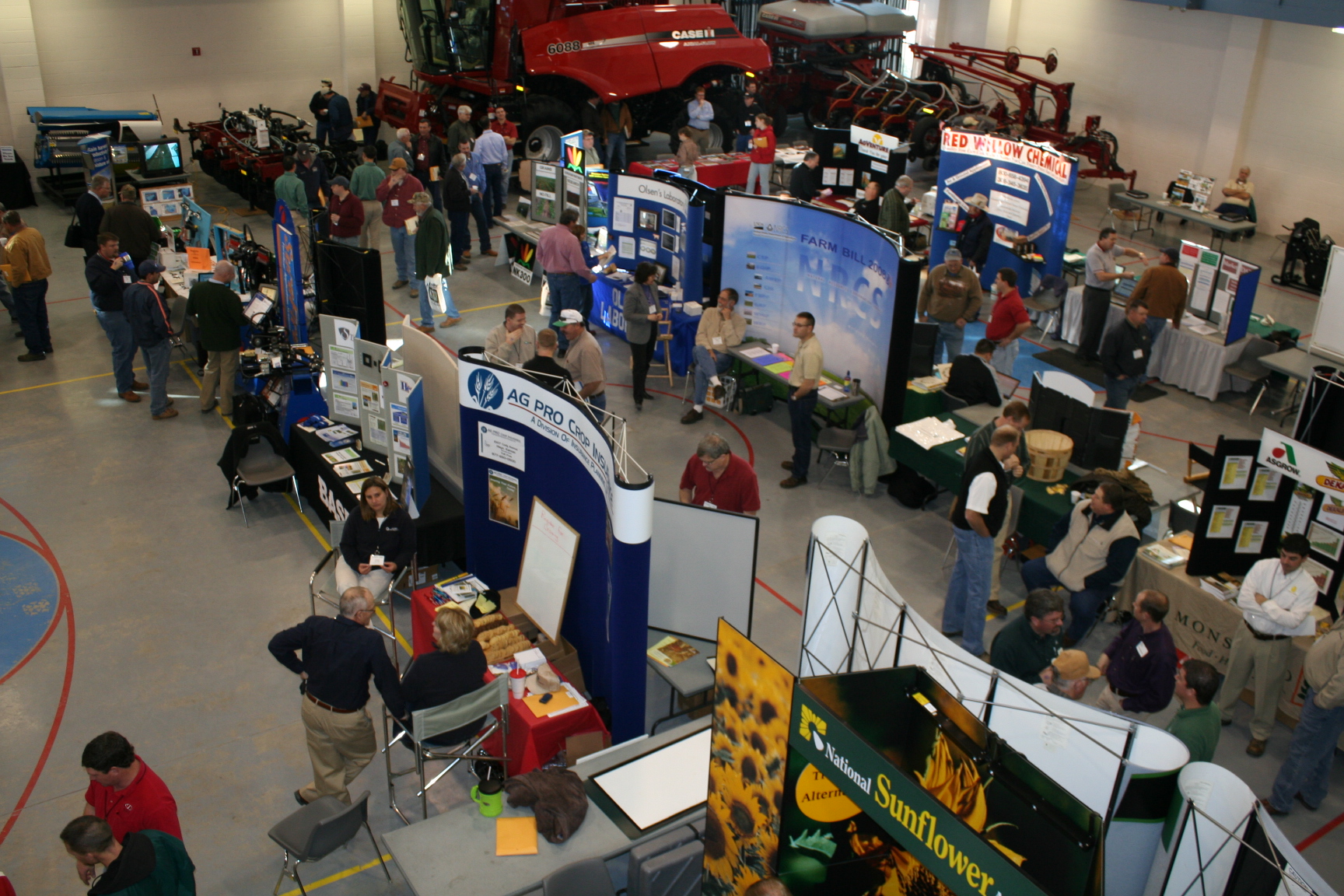
It was the same conversing environment at the 6th annual “Cover Your Acres Winter Conference” January 20-21 in Oberlin, KS, where more than 700 farmers gathered for the two day event of presentations focusing on the latest technology, methods and conservation practices to improve crop production on the High Plains.

“Cover Your Acres” was created in 2003 when the need was recognized for a conference providing comprehensive discussion of conservation crop production practices. The joint educational venture by Kansas State Research and Extension and the Northwest Kansas Crop Residue Alliance, a farmer driven group, began with a simple one-day conference. Since then the event grew, adding industry presentations and a second day with the same program allowing more farmers to attend.

“People come from all over too hear what’s going on and get ideas for new ways to do things on their farm,” said Jeanne Falk with the Northwest Kansas Research and Extension. “We’ve received good feedback each year, and it’s something producers get excited about. We’ve had some farmers that have continued to come back each year since it started.”

Falk said that the conference is about practical advice for productive farming on the High Plains. “It’s called ‘Cover Your Acres’ so naturally it’s a lot of no-till, conservation tillage issues, how to preserve the moisture we have in this location and make it the most profitable. The event also features an industry expo, which lets producers see the newest items available and visit with company representatives”

Some of the hot topics at this year’s conference were wheat residue management, weed strategies in grain sorghum and pros and cons of UAN with herbicides for wheat. Producers could also learn about advances in breeding technology, marketing strategies and even carbon credit trading.

In addition to the presentations two sessions featured panels of farmers who addressed the topics: things to do before you start to no-till and summer crop plant population.

When the conference is over, all attendees are sent a survey that allows them to evaluate the conference, individual presentations, ask them for ways the conference can be improved, and most importantly asks what topics they would like to see next year. The hot topics indicated on the survey lays the groundwork for next year’s conference.

“This year, weed strategies in grain sorghum was an area farms were really interested in and we get interest in the new technologies, some things farmers just want an update on and also other topics like carbon credit trading; something that’s not discussed a lot and yet it’s very applicable out here,” Falk said. “This conference is very producer driven—they help us pick the sessions, we also have the farmer panels, and the Northwest Kansas Crop Residue Alliance involved which is made up of farmers itself. The conference is very base and very applicable to farmers. We also try to choose speakers who are able to explain things and boil it down to what farmers really need and want to know.”

Farmers attending the conference appreciate the focus the conference puts on production. “They put on a good program and discuss issues that really affect us,” said Bob Martin, a Herndon, KS farmer. “I think it’s really important to have conferences like this and for farmers to continue learning because agriculture is continually changing.”

For those behind the scenes making the conference happen, seeing the end project and feedback from grateful producers makes it a rewarding event to be a part of. “It’s exciting to see farmers, extension specialists, university staff and area people come together for something this large,” Falk said. “It’s fun and exciting to hear what your neighbors are doing, what works for them and what doesn’t and to learn more about what’s going on in terms of research in the area. It’s also a great opportunity for people in research and extension to hear the needs and questions of producers. The conference is really a mingling of ideas and the sharing of information among those people who know and understand agriculture on the High Plains the best.”

With another successful year done, the future of the “Cover Your Acres” conference appears to be bright Falk said. “While we do strive to hold steady and even grow our attendance, the real mission for the conference is to keep it applicable for farmers and to make it worthwhile—that’s really what it’s about.”

Sunday, October 26, 2008

Kansas Swine Research Facilities


New swine facility will expand research capabilities at K-State and benefit producers

The Kansas swine industry is a vigorous business with producers marketing approximately 2.5 million pigs at a gross market value of over $3 million. Being the 9th top pork producing state and turning out 2.8% of the nation’s total production is no easy task; in fact it’s a team effort.

Leading the way through research, the K-State Swine Team works with producers and industry leaders to develop, evaluate, implement and disseminate the latest technology to increase the profitability of Kansas pork producers. Based out of K-State’s Department of Animal Sciences and Industry and armed with the support of the Kansas Pork Association, the KSU Livestock and Meal Industry Council, direct swine producers and allied industry donations; the Swine Team aims simply to educate producers.

“It’s a fairly applied program,” says Extension specialist, Bob Goodband. “We do a lot of research that we feel producers will find helpful and benefit from. We have the opportunity and ability to progress the industry, and that is something that we try very hard to do.”

To provide the best research requires the best facilities. The researching center is in the process of making an addition with a wean-to-finish facility. Extension specialist, Joel DeRouchey says the building will have the capability of weaning directly into this facility for research purposes. “This new building replaces an existing facility that was built in 1968, and also expands the number of pigs that can be housed indoors,” DeRouchey says. “Currently, dirt lots house pigs not used for research due to space limitations of the previous barn and those pigs for teaching purposes. This increase in barn size will allow for the removal of all outdoor lots, improving the environmental aspects of the farm by eliminating the need to contain rain runoff of the outdoor pens and reduce odor coming off of the dirt lots.” DeRouchey adds that the outdoor lots will be converted into crop ground with adjoining land currently in production.

DeRouchey says two of the four rooms will be identical in size and design, with 40 pens each capable of housing up to eight pigs per pen (320 total per room). “These research rooms will be fed with a state of the art computerized feeding system, FeedLogic, which delivers feed on a rail system and has capabilities of blending diets together as feeders are filled. This offers more flexibility in research design for nutritional trials.”

The other two rooms which are also identical in design, will have 22 pens capable of housing eight pigs per pen. “One of these rooms will house pigs for exploratory and pilot study research,” DeRouchey says. “The other room will house pigs that will be used for education and evaluation in the numerous undergraduate classes that utilize swine here on campus in our Weber Hall Arena. This room will also serve as the primary marketing room for additional pigs of various weights from the remainder of the university swine farm.”

DeRouchey also notes that the building itself will have the latest technologies of equipment, ventilation and feeding systems. The facility will also be utilized for educational training to graduate and undergraduate students to help prepare them for similar management techniques used in commercial operations.

Located at the edge of the K-State campus, the present Swine Teaching and Research Center has about 160 sows in production, which are of commercial line genetics. All females are bred by artificial insemination to terminal line boars. Sows are farrowed every 35 days and offspring are weaned into one of two nursery facilities. After seven weeks in the nursery facilities, pigs are moved to a growing facility or to one of three finishing buildings and utilized in research.

Goodband says current swine research is being done is promising for producers. “Right now our research includes looking at different types of feeders and feeder adjustments to see how it impacts performance,” he says. “We’re also doing some research on creep feeding to provid extra feed for piglets. A large focus is looking at DDGS feeding, with corn prices as high as they are, distillers are an economical alternative. Along with that we’ve been doing research on adding enzymes to feed to aid with digestability. When feeding distillers, there is a lot more fiber content so potentially by adding enzymes the fiber can be broke down a little better.” Goodband also mentions that researchers are always evaluating new protein sources for piglets and overall nutritional recommendations.

While construction crews are still bustling around the site of the soon to be building, the excitement is growing among Swine Team researchers who are eager put it to work. “One of our main focuses in the barns will be nutrition research to help producers best use ethanol co-products and other alternative ingredients in their swine diets without compromising pig performance or meat quality,” says Extension specialist Mike Tokach. “We are excited that the building will help us conduct research vital to helping Kansas producers deal with difficult production decisions.”

The hard work and research of the Swine Team doesn’t go unnoticed by the pork producers of Kansas. “The main jist of K-State research is to help producers lower the cost of production. About 60% of production cost is feed inputs, as grain prices have risen that percentage has went up considerably. What K-State does for producers is a very valuable resource,” says Kansas Pork Association President, Tim Stroda. “Much of the research that goes on through the K-State Swine Team heads towards the area of nutrition. Their research is very important to producers especially in times of high grain prices like now. Producers appreciate their ability and effort to help them make money. Our hope is that by supporting the facility enhancement project that producers will have that expertise at their fingertips for the next decades to come.”


Friday, October 3, 2008

Switching it up?

Switchgrass as an alternative crop? Not quite yet.


Cellulosic ethanol production is still in its infancy, with research increasing and only a handful of pilot plants in operation. However, biomass and cellulosic ethanol crops will drive the next wave of agricultural commodities and push producers to re-think crop selection. In time, alternative crops, such as switchgrass, could be a realistic option.


"At this time, it's grown as a cover crop on some CRP land and in some limited amount as a hay crop," says University of Nebraska-Lincoln professor Richard Perrin. "It has received attention as a potential biomass crop for the energy market, but these markets are still in the future."

Switchgrass is a warm-season perennial grass that is native to North America. Perrin says it is competitive with other grass crops in a wide variety of regions, throughout the Great Plains and the Southeast. Because of its native history, it is resistant to many pests and plant diseases and capable of producing high yields with very low applications of fertilizer.

Some fertilization may be necessary to maintain harvestable stands, says Ag Marketing Research Center specialist Dan Burden. The crop is proven to be very tolerant of poor soils, flooding and drought. Switchgrass is also a valuable soil protection cover crop - it binds loose soils and provides valuable wildlife habitat.

However, as a crop, switchgrass requires slightly uncommon management. For optimal output, it is harvested only every other year, rather than annually. Even though it's common in CRP fields, switchgrass harvested for energy generation must be a relative monoculture, meaning derived from primarily a single seed type, rather than part of a mixture of grasses. Once the grass reaches maturity in harvest years, it is swathed and baled, much like other forage crops.

Wednesday, July 23, 2008

A Brief History Of Barbed Wire

The Devil's Rope; Barbed Wire And The American Frontier

Most people have the opinion that barbed wire has never had more significance than its present day existence throughout the West. This mode of thinking neglects the history and the role that that barbed wire played in transforming American culture. Many technological breakthroughs have impacted the cultural history of our nation significantly. Barbed wire fencing was such a technology, and its invention and rise played a major role in the transformation of the frontier and West. Its effects were momentous, and they may still be felt and seen today.

The transition of open prairie to enclosures of barbed wire was actually a social revolution among the early-day settlers and ranchers. To some, it was a threat to job security, to others it was the only solution to continued living on the Great Plains. To most, it meant a complete change of traditions, daily work and the acceptance of a new way of life.

Since the beginning of time, man has constructed his barriers from natural materials adjacent to the barrier site. These materials were mostly wood from trees, stone, thorny brush, and mud. When settlers arrived on the Great Plains of America, they found these materials in short supply, thus creating a demand for a more economical type of fencing.

Dating back to 400 A.D., the process of pulling hot, bloom iron through dies in a drawing plate produced short lengths of various sizes of smooth wire. By 1870, good quality smooth wire was readily available in all sizes and lengths. Stockmen used the smooth wire in fencing but found it was not a dependable deterrent to livestock passage.

In 1867, two inventors tried adding points to the smooth wire in an effort to make a more effective deterrent. One example was not practical to manufacture, the other experienced financial problems. In 1868,. Michael Kelly invented a practical wire with points which was used in quantity until 1874

Joseph F. Glidden of Dekalb, Illinois attended a county fair where he observed a demonstration of a wooden rail with sharp nails protruding along its sides, hanging inside a smooth wire fence. This inspired him to invent and patent a successful barbed wire in the form we recognize today. However, Glidden along with Isaac Ellwood, a hardware merchant, and Jacob Haish, a lumberman, were all inspired at about the same time by a wood and wire device exhibited at the DeKalb County Fair of 1873. A local farmer, Henry M. Rose had created his contraption to control a “breachy” cow. Impractical as the device was, it was the inspiration that lead Glidden, Ellwood, and Haish into their experiments with barbed wire. Each man independently came up with their own fencing variations. Jacob Haish devised a design that turns out to have been similar but inferior to the design that Glidden was developing. Glidden fashioned barbs on an improvised coffee bean grinder, placed them at intervals along a smooth wire, and twisted another wire around the first to hold the barbs in a fixed position. He set about to improve his designs and he also set about obtaining patents on his inventions including a patent on his famous “S” barb that would lead to battles and much contention among the inventors.

Isaac Ellwood gave up on his own tinkering after seeing the superiority of Glidden’s design., the two men soon became partners in what would become the major barbed wire manufacturing concern in DeKalb. Recognizing a business opportunity

Glidden and Ellwood’s Barb Fence Company began manufacturing large quantities of its new wire., Glidden eagerly sold out his share of the business when the Washburn and Moen Company of Massachusetts approached the businessmen. The new I.L. Ellwood and Washburn & Moen Company soon acquired many of the existing barbed wire patents - important patents that gave them nearly undisputed control of the entire barbed wire industry. However,Haish played his part in insuring that this near monopoly didn’t come easily. It was a battle stretching into the 1880s involving the investigation of hundreds of claims, determining who had precedence, buying up patents, and defending against the claims of others. The advent of Glidden’s successful invention set off a creative frenzy that eventually produced over 570 barbed wire patents. It also set the stage for a three-year legal battle over the rights to these patents. Early on the founders of the Barb Fence Company recognized the potentially huge market for their barbed wire in Texas. However, as wonderful as its inventors and proponents believed it to be, they hadn’t reckoned on the resistance of the open range cattlemen. Wanting to return to his farming and leave the fencing business behind Jacob

Before the farmers came, much of Texas was dominated by cattlemen. These weren’t land owners with vast ranches of domesticated cattle. The cattle of this era were the wild Texas Longhorns and the cattlemen practiced a policy of open range use - driving the herds from South Texas north into the Panhandle and beyond along trails that knew no fences because much of it was public lands. The cattlemen were opposed to the migration of the “nesters” as they called the farmer-settlers.By extension, they were opposed to a product like barbed wire that might make it easier for the nesters to move into “their” land.

Two sales representatives sent to the Lone Star State played different but equally important roles in the introduction and spread of barbed wire throughout the state. Henry Sanborn, a relative of Joseph Glidden,Texas in 1875. Sanborn and his partner J.P. Warner met with a great deal of resistance from the cattlemen and the farmers as well who were all skeptical of this new product. It didn’t look strong enough to hold back one mean cow much less a whole herd. And there was a natural skepticism about anything produced “in the North.” They sold very little wire and returned to DeKalb a year later. Sanborn would return later on and make his mark not as a salesman as much as a forerunner in the “closed land ranching” experiments of the Texas Panhandle. was sent to

Many historians believe one of the defining moments in the history of the West came when a small bunch of wild longhorn steers stopped and backed away from eight slender strands of twisted wire equipped with sharp barbs. This event happened in 1876 when John W. “Bet-a-Million” Gateserected an enclosure on the Plaza in San Antonio, Texas to demonstrate to gathered ranchers, that newly-invented barbed wire could securely contain wild livestock. From that moment on, the West would never be the same again.

This defining event ended the era of open range and the use of free graze which had reigned supreme since the earliest settlers began to populate mid-America. At that same time, new technological inventions and modern manufacturing equipment and processes grew by leaps and bounds providing the start of the Industrial Revolution across America.

Post-war demands for beef here and abroad, new railroads available for livestock transportation and the invention of refrigeration spawned the greatest cattle boom in the history of the new nation. The cattleman was king and his domain seemingly unending. However, the moment those longhorns stopped at the wire in San Antonio, the age of the pioneer, free-range cattleman was doomed. No one foresaw how drastically barbed wire fencing would eventually transform western life at that time and on into the future.

Sales skyrocketed- from 5 tons in 1874, the first year of production, to 300 tons in the following years, surpassing 10,000 tons by 1878 and 100,000 by 1883. Steel barbed wire became more and more common during the late years of the century, when barbed wire was to meet humans rather than cows., fences now became a cheap, labor-efficient resource and so fencing could be extended not only in space but also in its intended uses. Instead of being a prohibitive element of cost

Surely, the changes required a few hectic and sometimes bloody years in transformation, but as inevitable as sunrise the vast ranges from Mexico to Canada were slowly claimed and their boundaries fenced with wire. The greater the adversity met in claiming and fencing the land the greater the pride-of-ownership in the land by the owner.

When livestock encountered barbed wire for the first time, it was usually a painful experience. The injuries provided sufficient reason for the public to protest its use. Religious groups called it “the work of the devil,” or “the devil’s rope” and demanded removal.

The last opposition fell when the large ranches in Texas began fencing their boundaries and cross fencing within. Among the first to fence were The Frying Pan Ranch, The XIT, and the JA Ranch, all located in the Texas Panhandle. Free range grazers became alarmed the economical new barrier would mean the end of their livelihood. Trail Drivers were concerned their herds would be blocked from the Kansas markets by settler fences. Barbed wire fence development stalled.

With landowners building fences to protect crops and livestock, and those opposed fighting to keep their independence; violence occurred requiring laws to be passed making wire cutting a felony. Cattlemen weren’t concerned so much with the barbed wire as they were with the loss of the public lands where they grazed their livestock.A drought in 1883 escalated the tensions because fences blocking the way made it harder to find new sources of grass and water for the herds.

Individuals or small groups felt it was their right, perhaps even their obligation to protect the public lands. The easiest way to do this was to destroy the fences and hopefully drive the squatters from “their” land. It was a relatively easy matter to snip the wires under cover of night. Most fence-cutters went unidentified and unpunished. Their fight might have been successful or totally unnoticed if it weren’t for the fact that the cause was picked up by men with less than honorable intentions. Thieves and cattle rustlers joined in the fence-cutting and what might have remained minor incidents escalated into violence and bloodshed. While illegally erected fences were the initial target, soon legal fencing came under attack and peaceful resolution of conflicts became more difficult.

While there was some sympathy for the nobler purpose behind the fence-cutting, at the height of activity in Texas the violence, including murder, became a serious threat to Western settlement and expansion. Farming and cattle-raising alike were disrupted. It finally became necessary for the Texas Legislature to step in.

In February 1884 new laws were rushed through the Legislature to help alleviate the problems. New fence installations required that public roads remain open and gates had to be provided at intervals where fence lines met public roads. Erecting fencing without consent of the landowners became a misdemeanor.Fence-cutting was declared a felony crime with one to five years’ imprisonment. The Texas Rangers were even called on to provide protection in certain trouble spots.

In other states where fence-cutting continued it took longer to bring it under control. But quick action by the 18th Legislature effectively ended the fence-cutters’ war in less than a year in Texas.The end to fence-cutting also signaled the beginning of the end of free, open ranges for Texas cattle.

A problem arose with the advent of extensive barbed wire fencing. As large ranches started fencing their checkerboard sections, they often fenced off access to the state owned sections located in between the privately owned sections. In certain areas, the fences were deliberately placed across known trails in an effort to keep new settlers out.This brought complaints to the state that the public was being denied access to Texas Public Lands.

The state took action in the courts making a single corner post to which all intersecting cross fences were tied, illegal. The public must be allowed to access the public lands. The land owners then countered with a new concept in which they set extra corner posts for each intersecting fence, leaving an eight inch gap in between the corner posts. A person could slip between but livestock were still blocked from passage.. However, juries decided there was an undeniable gap between the corner posts as prescribed by law and the state lost. This was legal but challenged by the state

After losing their cases, the state then passed laws requiring gates to be built at regular intervals giving access along trails and to the state owned sections thus ending the “8 inch gap saga.”

Every successful major change in history that survived to call an “era” was prefaced by need,, turmoil and often tragedy. An excellent example is “The end of the open range era” signaled by the invention and development of barbed wire fences. Not only did these new barbed barriers cause a drastic change in the way business was conducted, it dictated a monumental change in the life-style and culture of those who lived on the vast prairies of the West.

The first step in the conversion from open range and its nomadic culture to totally enclosed ranges had nothing to do with bared wire. This subtle change came when open range operators established invisible boundaries around chosen public areas and hired cowboys to patrol the boundaries on a daily basis.

The riders were called “line riders,” their crude abodes called “line shacks” and their duties included riding the invisible boundaries on a regular schedule turning away stray livestock not owned by the home ranch and gathering ranch-owned livestock back onto the premises.

At times and during patrols they pulled cattle from bog-holes, chopped ice in winter, hunted predators and joined ranch roundups and branding when needed. The guarding-the-parameters effort was very expensive, effective only in moderate weather, but offered the only alternative to control cattle at the time. The choosing of invisible boundaries by ranch owners became the first step in the evolution from a nomadic open-range culture to a total enclosed permanent culture.

These structures were considered cost effective as they eliminated much of the line rider’s work thus requiring fewer employees. By 1882, many such short sections of barbed wire fence were used by larger ranches. Since these fences were not connected together and were limited in length they were little noticed and offered little inconvenience to travelers.

Newcomers arrived on the Plains almost daily adding their herds to those already in place. Winter storms caused uncontrolled livestock to drift into the protected areas of rivers and creeks where they quickly depleted the coveted winter-graze of the ranchers. Numerous tactics were tried to prevent this loss but none were successful.

Though few ranchers would admit their losses were their own fault, they learned a lesson and changed their ways of operating. Within a few short years, the ranges were properly fenced, winter graze protected and hay stored for emergency use.

Barbed wire was created as a result of a special kind of colonization taking place in the American West. This colonization had two features that set it apart from earlier colonizing episodes. First, it was new in terms of space: an entire landmass was to be exploited. Second, it was new in terms of time: the colonization was to take place very rapidly. Earlier human expansions on similar scales had taken generations, but this one took no more than a few years.

Barbed wire was undeniably integral to the growth and expansion of the United States, including Texas. It changed the face of the plains, farming, and the cattle industry. Barbed wire was a practical solution to a problem, a lucrative business, a political hot potato, a symbol worth fighting over and instrumental in taming the West.


Friday, June 27, 2008

More than food & fuel

Getting More From The Kernel 


We often think of corn as a simple commodity, limited to either food or fuel. However, corn can be processed to utilize any or all of its four major components -- starch, protein, oil and fiber -- in thousands of applications, products and alternative uses.

Corn processing continues to find new uses, which benefit consumers around the world and create new markets for producers.

“As corn prices go up, there becomes increased interest in getting more out of it,” says Larry Johnson, director of the Center for Crop Utilization and Research at Iowa State University. Johnson says that while high corn prices have not had an effect on the amount of research being conducted, it has affected the focus.
“We believe you can produce both food and fuel from corn,” Johnson says. “Edible oil, high quality feed, stillage conversion, bran conversion, all of these things, we’re trying to get more out of corn than we used to get.”

Getting more out of corn is something that is the specialty of NatureWorks LLC. Using biopolymer technology, the company manufactures a plastic called polyactide (PLA) and Ingeo fibers, which are licensed to other companies that provide consumer goods. Because these products are corn-made, they use up to 68% less fossil fuel energy than traditional plastics and can break down into compost.

“Consumers are now brutally aware of how oil-based our economy is, not just in terms of what goes into our gas tank, but the products we buy,” says Steve Davies, global marketing director of NatureWorks LLC. “The consumers now get that we need better options. They are driving huge demands for these products today because they are so much more aware of the impact of what they buy and it’s influence on the environment.”

NatureWorks PLA and Ingeo can be found in a variety of products such as packing materials, carpet, hygiene products, fresh food packaging, cleaners, disposable tableware and apparel. Other products becoming more common included plastic gift cards, weed-blocking landscape covering, durable plastic electronic housings and baby diapers.

“Consumer reaction is typically surprised but positive,” Davies says. “Consumers have the idea that doing something good for the environment means giving up something. It’s viewed as something that wouldn’t work as well or look as good, and we’ve taken a lot of trouble to work with downstream manufacturers to make sure the product performs well, looks good and is good for the environment.”

While the acceptance and growth of these corn-based products has been impressive, Davies says the industry has more development to come. “NatureWorks LLC started in 2003 the world’s first and largest bio-plastic facility, and yet it’s still tiny in terms of the global plastic and fiber market,” Davies says. “What we see going forward is PLA, Ingeo and other bio-plastics becoming a fact of life and the norm.”


This growing market which offers new uses for corn will also benefit producers, says Nathan Fields, director of research and business development for the National Corn Growers Association (NCGA). “If we can diversify the use of corn it will create more marketing opportunities and ultimately help corn growers,” Fields says. “Technology and research in terms of processing is continuously developing, there are a lot of promising applications to be excited about.”

Interested in these new value-added corn products? Check out some of the merchandise on retail shelves that started in a corn field.

-“We milk the cows and grow the bottles” is the motto of Naturally Iowa, Inc. The company packages its certified organic dairy products in PLA containers through a partnership with NatureWorks LLC. For more information visit www.naturallyiowa.com or call 712-542-MILK.

-Mohawk Industries and DuPont’s SmartStrand carpeting is made of readily available agricultural materials, including corn. Stylish, durable and environmentally smart, you can enjoy your corn crop year round right in your living room. For more information visit www.mohawkcarpet.com/carpeting/smartstrandor call 800-2MOHAWK.


-Looking for a unique company promotional item? Corn-based biodegradable plastic mugs, pens, letter openers, rulers and golf tees are available at www.cornmug.com, or call 425-681-2460.

-Get a good night’s sleep with Ingeo fiber pillows and comforters. Available at home stores, these bedding goods offer superior performance and insulation, luxurious comfort, lasting, springy loft and exceptional durability. Visit www.target.com, www.cozywinters.com, or www.bedbathandbeyond.com for more information.

-Look good and feel good by wearing an Ingeo shirt from EcoWear USA of Eden Prairie, MN.  Available in various styles and colors these wrinkle-free, easy care durable shirts will surely make a fashion statement. Furthermore, at the end of its useful life, your Ingeo clothing is fully recyclable. For more information visit www.ecowearusa.com.

-Sam’s Club and Wal-Mart Super Centers now offer PLA packaging on fresh cut fruit, herbs, strawberries, Brussels sprouts and bakery products. Research indicated that with this change to packaging made from corn will save the equivalent of 800,000 gallons of gasoline and reduce more than 11 million lbs. of greenhouse gas emissions.

For additional listings of corn products made using NatureWorks LLC Ingeo fiber and PLA, visit www.ingeofibers.com and www.natureworksllc.com. There you can find more information about the variety of products and where to buy them.

For a complete listing of all products made with corn, visit the NCGA product search page at http://www.ncga.com/research/comm_dev_center/index_PG.asp.

Thursday, April 24, 2008

Efficient spraying- more for your money

Applying efficiency to your spraying routine

When is comes to spraying, the chemical is only as effective as the application process itself. With a better knowledge of equipment and product, producers can increase spraying efficiency.

Robert Klein, University of Nebraska- Lincoln extension cropping systems specialist, has been offering producers advice through workshops, which include more than simply sprayer calibration. “Calibration is very important, but before we start spraying we take a pressure gage and check the pressure on the boom,” Klein said. “This is critical because often it’s found that there is not even pressure throughout the boom. If the pressure is not even across the boom, calibration is a waste of time.” Klein also recommends checking the pressure gauge in the cab to determine if there is a difference, either high or lower in the boom.

Calibration of sprayers includes speed, spacing and nozzle flow rate. Robert Wolf, K-State extension application technology specialist, stresses the importance of setting up a sprayer properly. “Producers need to be actually putting out the amount of chemical that they think they are in order to get effective coverage,” Wolf said. “A lot of times a farmer or commercial applicator is going through the field and paying attention to the rate controller and may not have a good feel for what’s going on in the droplet situation.”

Spray nozzle tip selection is a topic producers should become familiar with. “It’s important to know where various nozzles should be used and what pressure it should be used with,” Klein said. “Different nozzle materials offer different advantages - brass, plastic, stainless steel – you really have to know what your purpose is and what type of droplets are desired.”

A concern is that the nozzles are not putting out the correct amount, or that there is a pattern problem and coverage might not happen as accurately as it should, Wolf said. That’s really a critical issue when you’re trying to get coverage on the targeted surface. “Some producers in Kansas are operating on the edge with low volume of application, and with lower volume of application the more risk you have because it’s smaller droplets and less material being put out,” Wolf said. “If it’s a hot, dry windy day the coverage lessens, and that is something to keep in mind.”

Wolf said it’s important to get the sprayer set up to deliver the right size of droplets. “Applicators are getting more and more focused on that because we are learning that certain types of weed targets are going to require different kinds of coverage and droplet size aspects than others, and the sprayer must be set up for it,” Wolf said. “That is going to require applicators to have a pretty good knowledge on the type of nozzle they are using.”

Klein and Wolf both exhibit a nozzle demonstration at their various spraying workshops and seminars. By using a spray table and strobe light to show the various particle sizes and nozzle types, producers are able to see side-by-side the advantages and disadvantages of each nozzle. “We try to illustrate what the different nozzle technologies will do through our demonstrations,” Klein said. “It gives the operator a visual picture of how the nozzle will perform and after seeing the difference producers understand why it’s so important.”

Chemical companies are starting to do more research to identify what droplet sizes might be in order for farmers to better set-up the sprayers, Wolf said. Also, nozzle manufactures are providing data to the farmers, that information can be used to select the right nozzle for the job. “Chemical labels are also starting to address the droplet size issue,” Wolf said. “The American Society of Agricultural and Biological Engineers has adopted a standard which the EPA is promoting and chemical companies are starting to use. That standard specifies a droplet size spectrum broken down into six categories; very fine, fine, medium, coarse, very coarse and extra coarse.”

Other technologies such as auto-steer and boom control provide opportunity for more efficient application. “Boom height control can be used to maintain a uniform height across the field,” Wolf said. “Boom swath control with GPS and a rate controller system keeps track of areas that are sprayed and not sprayed. The boom will turn on and off in segments so that applicators don’t double spray or miss spots.”

Wolf has noticed that more farmers in the Midwest are doing their own spraying than in previous years. “With the technology changing everyday and the newer nozzles it’s very important that we have the various programs through extension service to get information to applicators,” Wolf said. “From my experience producers are very interested in learning more about the topic, they will come to the meetings and ask good questions - this education something that’s needed.”


pH testing on the go

Technology makes variable-rate liming easier


Maintaining suitable soil pH has long been a concern and headache for many crop producers. Conventional soil sampling is laborious and costly - especially true when farming in a site-specific manner. However, new technology makes variable-rate lime application affordable and practical with on-the-go soil pH testing.

“Variable rate liming is one of the most profitable and popular practices in site-specific crop management,” says Viacheslav Adamchuk, precision agriculture engineer at the University of Nebraska - Lincoln. “In addition to knowing acidic field areas, having knowledge of areas with alkaline soil conditions (high pH) can be useful to avoid lime application in these areas and also aid in the selection of crop varieties tolerant to problems associated with high pH.”

Currently, most variable rate lime prescription maps are gener­ated based on soil samples collected manually and analyzed in laboratory conditions. These samples are usually obtained with a 2.5-acre sampling frequency. With on-the-go testing, samples are taken at a greater density and at a relatively same or lower cost. Adamchuk says that the economic benefits of variable liming through advanced pH maps can range between $5 and $15 per acre, with significant environmental benefits as well.

In 2004 Veris Technologies of Salina, Kan. began marketing the first on-the-go pH mapping device- the Mobile Sensor Platform (MSP) pH Manager.

People see it work and say, ‘It’s so simple anybody could have thought of that’,” says Eric Lund of Veris. “The fact that the unit is one moving part makes it jaw dropping simple.” Lund explains the main concept of design is a cutting shoe that goes beneath the ground allowing soil to flow through horizontally creating a soil core. The shoe is then picked up hydraulically and the soil is held against two pH electrodes for 10 seconds while a reading is stabilized. During each cycle the shoe is cleaned off by a scraper and the pH electrodes are washed off with water nozzles. The sampling process is controlled with an external electric control module and the pH data is recorded.

Lund says the system is predominately used in places where people apply a lot of lime. “pH is really an issue in the eastern Midwest as well as other pocketed areas. Producers that spend the money to put on lime need to determine the pH better than what they have been.” Lund also says that the majority of pH Manager sales are to Co-op’s, agricultural retailers and large farmers. Approximately one third of Veris sales are over seas.

Steve Kramer, technology manager for Servi-Tech in Stromsburg, Neb. has been using the pH Manager since 2003 and sees the benefits the technology has to offer.

“It takes a lot of variability out of the picture when you’re trying to record pH,” Kramer says. “In fields that have pH issues you only want to address the areas that need it. With the price of lime you want be as efficient as possible - it’s too expensive of an input to go out there and put two tons on the whole field. It makes more sense to put it where you need it or to not put it where you don’t need it.”

The greatest advantage of on-the-go testing is variation in sampling density and reduced labor costs. Lund says that lime requirements simply vary too much within a field to allow the computer to fill in the gaps between a handful of samples.

Using grid sampling the pH at each point is determined in laboratory testing, which is better than on-the-go readings,” Lund says. “With grid sampling the space between the points is then automatically filled in. However, there’s more area of the field between the points than there is at the points.”

When grid sample sites are overlaid on a pH Manager map, it’s evident that there is more variability than grid samples will be able to capture, Lund says. “Software may contour the grid spots into a pretty map, but it can’t accurately map what wasn’t measured.”

After a pH map is made using on-the-go testing Kramer and other consultants use the results as well as buffer pH and soil texture information to generate lime recommendations. Kramer says this helps the producer put the right amount of lime where it needs to go. “With the Veris map producers typically use about the same amount of lime. The difference is that they’ll know to put less where they don’t need it and more where they do.”

K-State agronomist, Scott Staggenborg, says that on-the-go pH testing can help producers make more informed management decisions. “When researchers began looking at variable rate inputs in the early 2000’s it became obvious that lime would be significant because of the cost of the material and the fact that it is spatially oriented,” Staggenborg says. “Grid sampling was just not dense enough to make the decisions that needed to be made. The real-time sensors make the most sense and the biggest advantage is that you get a very dense data set.”

Certain crops are more susceptible to suffering from lime deficiencies Staggenborg says Soybeans, alfalfa and wheat are crops that can experience harmful lime deficiencies. In legume crops, low pH inhibits the bacteria necessary to starting the nitrogen fixation process which reduces nodulation. Wheat under low pH can suffer from toxicities, most notable being aluminum toxicity. This means that having soil with suitable pH can be very important and fixing pH problem areas more accurately only makes sense.

Is it really possible to test soil with out the laboratory? As with any new technology, some may be skeptical of on-the-go pH testing and the accuracy it provides. “Not only is it being done in a field, its being done on a piece of equipment that is bouncing and moving along at about 4-8 mph.” Staggenborg says. “The trade off is while the samples may not be as accurate as those from a laboratory, we get them at a more dense rate and we get them right now.” Staggenborg also says that it doesn’t necessarily have to be completely accurate because producers are putting on tons of material. Lime applications are not as finely tuned as other elements and on-the-go testing is accurate enough to pick up substantial variations. Results from field, static and lab tests show that the on-the-go method produces pH measurements that are highly correlated with laboratory analysis of soil pH.

While the system may not be flawless, the technology is by far a step up from other forms of pH sampling. “Pinpoint lime application is the main benefit; you know what your pH is,” Lund says. “You know you need some lime here, a little here and a lot over there. Lime is expensive, with this type of mapping it easier to choose which areas to apply lime and help farmers make better management calls.”