Wednesday, January 20, 2010

Telling the agriculture story in the social media age

Keeping Up


Facebook, Twitter, YouTube, MySpace, LinkedIn.

Chances are you've at least heard of these terms. They are all part of the rapidly growing social media network - the set of free online tools that allow the building of relationships between individuals sharing interests, information and ideas.

But why should farmers and ranchers care? Why should producers take the time to log on to social media? It's pretty simple: social networking sites offer the opportunity to reach millions of people with just a few clicks. These are tools that aren't just for teenagers or the tech savvy anymore. Social media has become mainstream - a place where the agriculture voice is not always heard.

"Social media offers us the ability to reach the 99 percent of the population that isn't in production agriculture," said Debbie Borg, chairman of the Nebraska Soybean Association who farms with her family near Allen, Neb. "When people understand why we do what we do, they are okay with it. But if they don't know, then all they hear is the other side."

Borg joined Twitter in March 2009 (user name @iamafarmer2) she's on Facebook and has a blog (www.ouragstory.blogspot.com). She Tweets about the daily happenings on the farm to followers from around the country.

"The consumer is so removed from the farmer that there is a growing awareness of wanting to know more about their food," Borg said. "It's become very obvious that we in agriculture must start talking with those outside our neighborhoods. Social media is a great way to reach more people with things we do on the farm everyday. If I can educate just one person a day, that's one more person who knows the truth."


It might start with educating just one person, but the numbers and breadth of social media are impressive and still growing.

Facebook, the popular social networking Web site, allows friends, classmates, colleagues and others to connect and share photos, messages and information about their lives with people in their network. It has more than 350 million users, and if it were a country, it would be the fourth largest in the world, according to Nielsen Co.

The newcomer in social networks, Twitter, is a cross between text messaging and blogging, where users are prompted to answer the question, "What are you doing?" in 140 characters or less. The site has grown 200 percent in the past year and estimates more than 26 million users in 2010.

Video sharing Web site YouTube is now the second largest search engine in the world and uploads 13 hours of video every minute of every day.

All of these networks and others can be linked together and even carried with you on your iPhone, BlackBerry or Driod to keep you constantly connected and updated.

"Social media allows us the opportunity to tell our story from the comfort of our own operations instead of having to leave our businesses and travel to speak to the public," said Lincolnville, Kan., rancher, Kim Harms. "In essence, social media outlets allow us to invite the public into our lives, homes, families and businesses to see the truth - not just hear others opinions."

Tuesday, January 5, 2010

Return to the Ranch

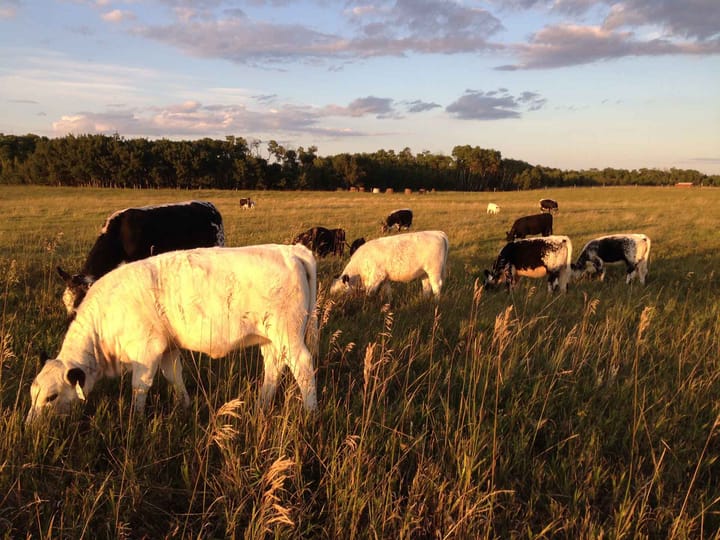
Cashing in on individual cattle management


You cannot manage what you cannot measure – the simple principle of the Decatur Beef Alliance which aims to get progressive producers out of the commodity business and into the value-added beef business.

Since 1971 Decatur County Feedyard, just North of Oberlin, Kan, has been in the commercial feeding business under the leadership of owner Warren Weibert. The feedyard has a one-time capacity of 40,000 and is turned over about 1.75 times a year. The focus is on retained ownership customers and improving long-term profitability through information. Decatur County Feedyard began sorting cattle by ultrasound in 1987, and was the first commercial feedlot to sort cattle with a video scanner.

In 1994 the Decatur Beef Alliance was established and the facility invested in Micro beef Technologies’ ACCU-TRAC Electronic Cattle Management System as part of a Total Quality Management approach to beef production.

The alliance enables producers to maximize profit from the genetics bred into the cattle and strengthen the relationship between ranchers, feeders and packers.  The program is rooted in the management principle that beef quality and consistency can’t improve, nor can profits, unless the information necessary for genetic selection is passed back to the producer.

“We focus on individual management,” says Director of Supply Development, Dan Dorn. “Our ultimate goal is to better the return to the ranch and increase the ranchers’ profitability.”

Dorn works with more than 200 regular customers spread across the U.S. from Florida to Hawaii, primarily involved with retained ownership. He works closely with cow/calf producers on advising, reviewing and offering recommendations for genetics and marketing.

According to Decatur County Feedyard results, individual management in the feedyard produces an average $15 per head performance advantage over group management. Timely marketing on a value-based grid system adds another $5 to $10 per head advantage. The greatest potential for higher profits however, is back at the ranch where genetic improvements based on individual performance and carcass data can bring another $50 per head profit. The wealth of individual performance data provides the producer the opportunity for another level of herd management.

Fruitful Plains

A mouth watering look at Kansas grown produce.


For some Midwest farmers agriculture is not about amber waves of grain, but rather the fruitful plains.

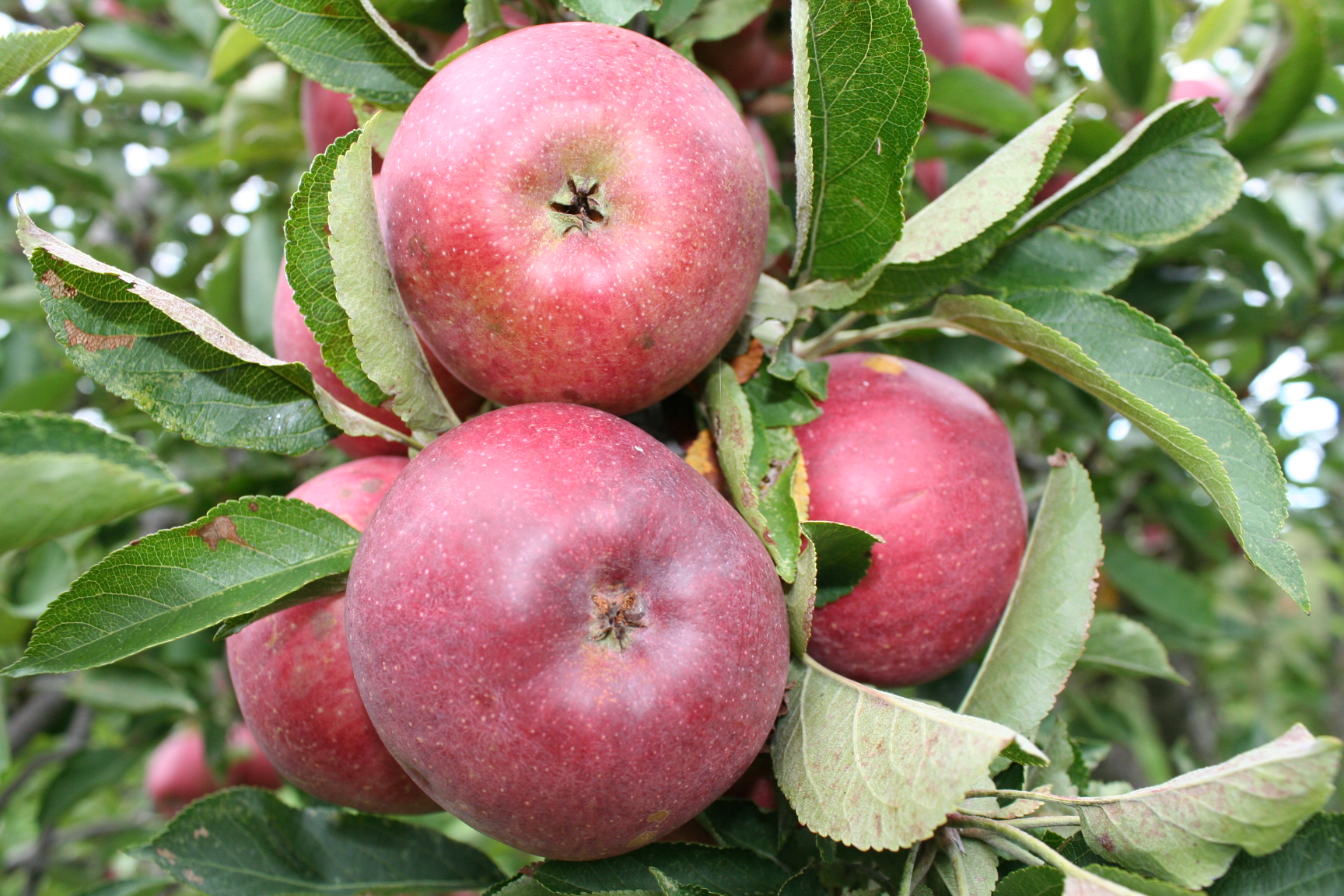
Nestled near the Kansas River just east of Topeka is a fruit farm with roots deeper than the apple trees they grow. The sole survivor of an area that once bustled with fruit and vegetable production, Rees Fruit Farm has more than 100 years of experience under their belt and is still going strong.

“As long as there have been Kansas farms, there have been Kansas orchards,” says Rex Rees who owns and operates the farm with his wife, Shannon. “It has its challenges but you just have to find a way to adapt.”

Their farm consists of roughly 5,000 fruit trees including 19 varieties of apples and 14 varieties of peaches. Cherries, grapes, tomatoes, asparagus, pumpkins, blackberries and a plethora of other fresh produce and goods can be found in the Rees Fruit Farm market.

The establishment is also home to award winning apple cider and the original Sweet Apple Cider Slush, a trademark of Rees Fruit Farm that continues to be a top seller.

How did the farm keep going through the years when other didn’t? Rex says it was a combination of things—including luck. “We’ve always had a retail market” he says. “We have a good location; close to the city but on a side that is less developed. The land isn’t so valuable that we can still afford to farm it.” Another key ingredient to success: satisfied customers. “We’re always trying new things to keep up with trends, and keep people coming back.”

Growing fruits and vegetables in the Midwest is not always easy. Like every farm, they must deal with what they’re dealt and in some years that means turbulent growing conditions. High temperatures, low temperatures, humidity, insects, disease; it’s not the most ideal place to grow—but it works.  “The thing about locally grown produce is that it doesn’t look like what you get at the grocery store, but the taste is so much better,” Rex says. “Our tomatoes may not be identical and flawless, but they taste delicious and that’s what matters most.”

Consumers craving locally grown produce are seeking out fresh fruit stands and farmers markets like never before to have a taste. In 1987 (the first year markets were surveyed) Kansas was home to 26 farmers markets. Today that number has almost tripled to the current census of 80 markets statewide.

Sunday, August 9, 2009

Irrigation Face Off

Center pivot or subsurface drip?


Farmers are professional decision makers. In every aspect of their work they are faced with choices and options to consider, even when it comes to irrigation systems.

Subsurface drip irrigation or SDI, a low-pressure, high efficiency irrigation system that uses buried drip tubes or drip tape to meet crop water needs is one option. SDI technologies have been a part of irrigated agriculture since the 1960s; with the technology advancing rapidly in the last two decades.

But how does an SDI system stack up to the more popular center pivots that roll over many of the irrigated acres in the Midwest?

“SDI systems are generally thought to be at least as efficient in terms of irrigation water use as center pivot irrigation systems, primarily because they avoid the evaporative losses that occur from exposing irrigation water on the soil surface and in the open above ground environment,” said K-State Extension Specialist, Daniel O'Brien.  “At K-State we have used conservative estimates of 10-20% water savings efficiency with SDI compared to center pivot irrigation.  In field situations were irrigation water availability is not limited, these efficiency gains may not be that important.  But where irrigation water supplies are more limited, 10-20% efficiency gains in irrigation water use could be extremely important and beneficial to an agricultural producer.”

It’s the system’s efficiency that attracted producers Jim and Jeff Reinert, a father/son farming duo from Ensign, KS. Their farm includes two separate SDI systems both 60 acres each, one with 30 inch tape the other with 60 inch.

“The thing you ultimately look for is the value of water,” Jim said.  “As water becomes more and more important to us, it’s something we need to do a better job of conserving.  We also want to be more efficient with our water allocations in relation to our acres. If we can maximize the productivity with a drip tape system to better use our water—that adds a value that is extremely important. Everything we can do to conserve water can only work in our benefit. I’ve been irrigating for the better part of 50 years and I hope my son has that same capability.

Wednesday, May 20, 2009

Prairie Pumpers

International Windmill Trade Fair coming to Kansas


Swiftly turning blades atop soaring towers have long claimed residence to the Midwest skyline. There presence sprung from necessity, but now the windmill is an icon of agriculture and rural life on the plains. Evoking thoughts of days gone by and sometimes satisfaction that certain things never change.

Windmill Fair 051The history and people behind these water pumping structures are almost as iconic as the windmill itself. Windmillers, dealers, restorers, collectors and enthusiasts from across the country and beyond, will soon unite at the 21st Annual International Windmillers’ Trade Fair, June 3-5 in El Dorado, Kan.

“The purpose of the Trade Fair and Convention is to buy, sell, trade, show and talk about water pumping windmills,” said organizer Chuck Jones of Benton, Kan.  “Some bring their junk iron to sell, some come to buy the junk iron.  Others come to see all the different kinds of Windmills and to learn more about them.  About a third of attendees are full time windmillers, a third collectors, and the other third just like windmills and the other items that go with it.”

The loosely organized group of steadfast windmillers has met in many locations over the years, but never before in Kansas. “We are really looking forward to the windmillers coming,” said Darla Stewart of the El Dorado Convention and Visitors Bureau.They’re really a great group of people with good camaraderie. They swap and trade parts, share stories and pictures of unearthing windmills and learn about what the others are doing.”

The trade fair will feature historical tours, social events and all-day vending. A lecture will be presented by noted windmill historian, T. Lindsay Baker. Baker is the author of “A Field Guide to American Windmills” which is considered to be the windmillers’ bible and the most comprehensive book on the subject.

Sunday, March 8, 2009

Good to the last droplet


Keys to calibrating your sprayer to get more bang for your buck


A miscalibrated sprayer is like a box of chocolates – you never know what you’re going to get. Maybe you’ll get proper coverage or maybe it’ll be lost to drift.

Accurate calibration is the only way to know how much chemical is being applied to your field. Even with the current use of electronics to monitor and control the application of crop protection products, a thorough sprayer calibration procedure is essential to ensure against misapplication. Failure to calibrate a sprayer can injure your crop, cause pollution and worst of all waste money.

“The sprayer itself needs to be operating as efficiently as possible,” says Bob Wolf, K-State extension application technology specialist. “Especially the first time out in the spring, you need to make sure your sprayer is all tuned up. That there are no leaks, the pump works properly, nothing is plugged and every component is functioning properly including electronics.” While that may cover the basics Wolf says there’s more to the calibration process.

“Take into account what kind of coverage the chemical will need and pick the right nozzle type to maximize it’s impact,” Wolf says. “Applicators need to consider what type of activity the chemical has, whether it needs contact area or if it will translocate through the plant, then calibrate for the system to best deliver the proper amount on the target.”

When it comes to selecting nozzles, there’s certainly a plethora of choices these days but no singular silver bullet says application technology research scientist with Syngenta, Dan Kidder. He finds nozzle manufacturer catalogs and the pesticide product labels very helpful in making this decision. “It’s tempting to try to make one set of nozzles work for all products by changing your sprayer pressure and ground speed,” Kidder says. “But with the diversity of products typically used on today’s state-of-the-art farms this strategy will almost always result in less than optimum application of some of the products. Less than optimum coverage requires higher product use rates and may cause unnecessary environmental loading. It pays to invest in several sets of nozzles for your different products. And better yet, install swivel style multiple nozzle bodies on your boom so you can change spray tips with just a flick-of-the-wrist.”

Some nozzles also produce a broader spectrum of droplet sizes, another important aspect of in terms of crop protection application. “Droplet size impacts coverage and droplet size impacts drift,” Wolf says. “Somewhere we have to find the happy medium because the common thought is smaller droplets means better coverage but we come against some things in the environment that prevent that. Smaller droplets will drift easier and some applicators overlook the evaporation concern. Especially in the Kansas and Nebraska areas that can have wind and dry conditions it’s definitely something to keep in mind.”

An adopted standard specifies a droplet size spectrum broken down into six categories; very fine, fine, medium, coarse, very coarse and extra coarse. Product labels are now featuring the recommended droplet size to improve application performance.

“Applicators are getting more and more focused on droplet size because we are learning that certain types of targets require different kinds of coverage and droplet size aspects than others and the sprayer must be set up for it,” Wolf says. “It’s going to require applicators to have a pretty good knowledge on the type of nozzles they are using and relate that to the product recommendation for droplet size.”

But how much difference does size really make? A drop is a drop, right? Not when talking about spray application, where every drop counts. “A change in droplet size has a huge effect on the number of droplets applied per square inch,” Kidder says. “For instance, reducing droplet size by half increases the number of droplets applied per square inch by eight times. Large droplets drift less than small droplets so spray losses are minimized. Large droplets also penetrate crop canopies better to reach the lower leaves; which is important for some fungicide applications. But smaller droplets cover the upper canopy better and are also better at providing some coverage on the underside of leaves.”

Kidder also suggests applicators match droplet size to spray volume. “If you’re lowering spray volume to save time, reduce droplet size to maintain quality. Higher water volumes result in higher operating cost due to more time and energy traveling to and from the refill site and soil compaction is sometimes a consideration when hauling high volumes of water back and forth across the field.”

Spray application is not what it use to be. For good reasons growers seem more focused than ever on reducing costs and optimizing sprays. “Producers pretty much know how to calibrate to get the right orifice size to deliver the right gallons per acre,” Wolf says. “But now there’s more to it, they have this droplet size spectrum concern in there and that may force them to take calibration a step further. The underlying key is to understand the application system and ensure that it is as efficient as possible so that it performs well in the field.”

Wednesday, February 4, 2009

Lean, Mean, No-Tilling Machines

Producers gear up for planting season with proper equipment


You carefully plan your crop rotations, shop for seed varieties, budget wisely for chemicals and analyze the markets. But nothing is more important than getting your no-till crop off to the right start with proper seeding.


no-till-equipment-015Attaining good stands in no-till requires hard working planters and drills that can handle residue without the hassle of plugging, penetrate the soil to the desired seeding depth, establish proper seed-to-soil contact and effectively close the seed-vee.


“Having the right equipment, functioning properly is one of the most important factors in no-till,” says Sterling, KS no-till farmer, Lee Scheufler. “It may seem expensive or tedious—but it’s time and money well invested.”

Scheufler and his wife, Margaret, began no-till farming in 1996 after seeing success with on-farm trials. “We decided to gradually switch from conventional tillage to no-till over several years, but in terms of equipment and mindset it was difficult to do both. By 2002 we were 100% no-till with a capital ‘N’ we do as little to disturb the soil as possible.”

The Scheufler’s do that by keeping it simple, yet being open minded. “As far as equipment—we don’t do anything exotic, it doesn’t have to be fancy to get the job done. We have always been the type to test things for ourselves before completely adopting it.”
Keeping with the idea of “try before you buy” the Scheufler’s also do custom work, making it possible for other producers in the area to try no-till without long term commitment. “It’s really about finding what works best for you,” Scheufler said. “It’s not about what everyone else is doing, or having the biggest or best —but about what fits your farm and operation.”

By evaluating the strengths and weaknesses of any piece of planting equipment and making few (if any) adjustments— many available planters and drills can be no-till worthy,, said University of Nebraska-Lincoln Extension Engineer, Paul Jasa.


With appropriate weight, down pressure and adjustments, most current planters and drills will perform well in no-till conditions, Jasa said. A little time spent in the early spring will help avoid headaches and delays later during the planting season, so consider your equipment needs now.